
If you’re reading this, AI agents are already moving through your organization’s systems. They’re writing code, calling internal and third-party APIs, moving data between SaaS tools, and automating workflows across cloud environments, local machines, and on-premises infrastructure.
Each of these agents authenticates somehow. The question isn’t whether your agents are authenticating, it’s how. And that choice, often made hastily by a developer trying to ship quickly, directly defines your blast radius or in other words fallout when an agent gets compromised or misused.

The uncomfortable reality
Some AI agents are built with modern, identity-aware authentication methods. Others rely on long-lived API keys, personal access tokens, or secrets pasted directly into configurations, prompts, or source code. The choice is rarely documented in any central registry, but it fundamentally determines what an attacker can access when things go wrong.
Here’s the key thing to remember: your authentication method is your blast radius.
Weak authentication gives attackers everything. Strong authentication contains the damage. The difference between these approaches isn’t just technical. It’s the difference between a contained incident and a company-wide breach.
Four criteria that actually matter
When evaluating authentication methods for AI agents. The most important thing is how these methods stack up against four practical criteria:
Security: How well does the method resist leakage, replay attacks, and abuse? Can it support least privilege for agents, or does it hand over the keys to the kingdom?
Usability: Can developers actually implement this without friction? Will security teams drown in operational overhead, or does it scale with your team’s capabilities?
Scalability: Can this approach support dozens or hundreds of agents across multiple environments without collapsing into unmanageable exceptions?
Revocability: When an incident occurs (and it will), how quickly can you kill an agent’s access? Minutes? Days? Can you even identify which credential belongs to which agent?
The five-tier hierarchy
Based on these criteria, authentication methods for AI agents fall into a clear hierarchy, from strongest to weakest:
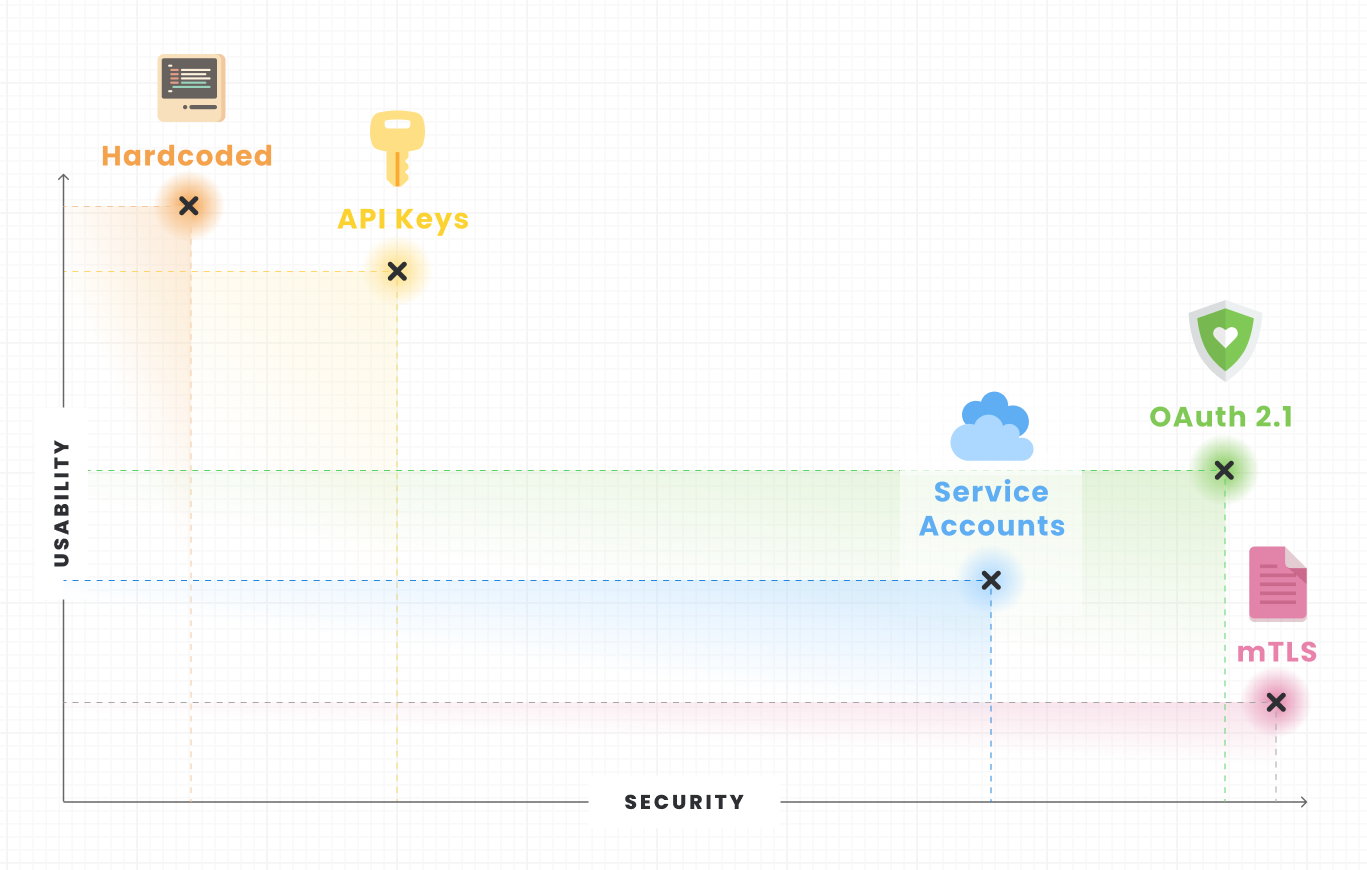
OAuth 2.1 with short-lived tokens (best overall)
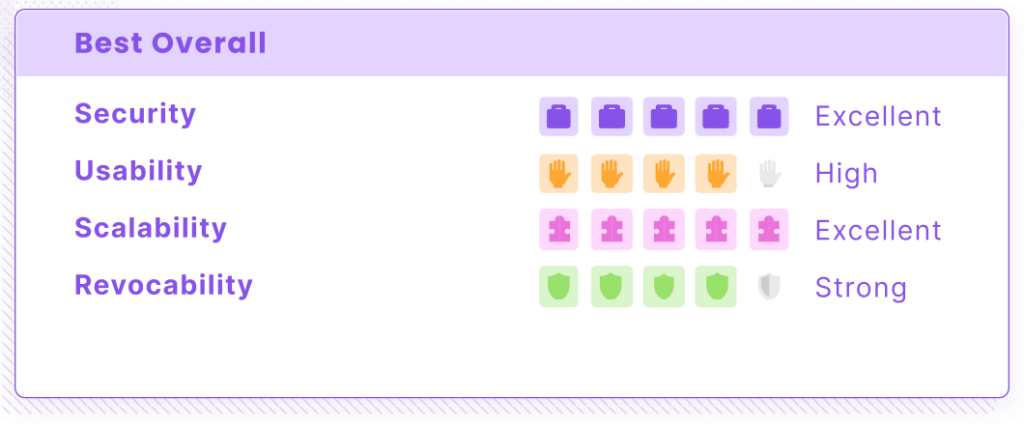
OAuth 2.1 with OIDC represents the gold standard for agent authentication. Instead of handing agents a permanent password, you issue short-lived access tokens with explicit scopes that define exactly what the agent can do. Leading frameworks like Anthropic’s Model Context Protocol specifically recommend OAuth because it eliminates hardcoded secrets and provides delegated access with built-in authorization controls.
Best for: Third-party SaaS integrations, cross-organization APIs, internal enterprise services where you want standardized, federated authentication.
Service accounts and workload identity tokens (best for trusted environments)
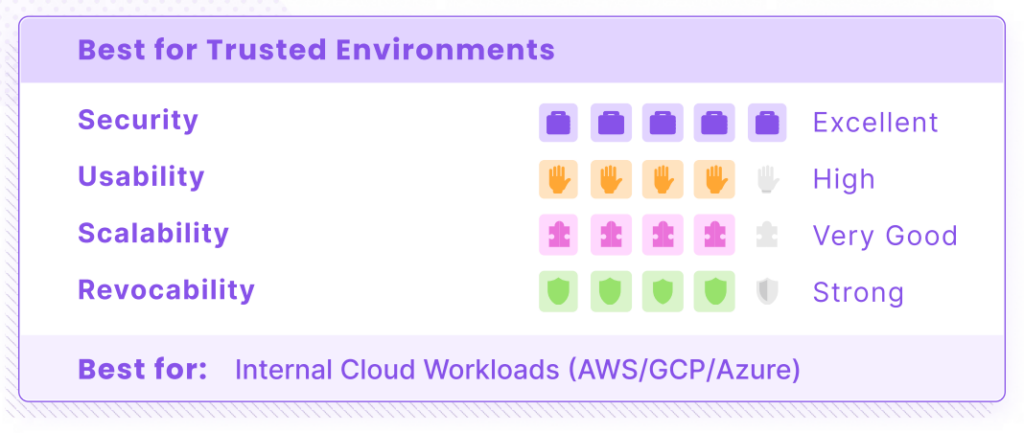
For agents running in trusted cloud environments, leveraging the cloud provider’s built-in identity mechanisms is a robust choice. AWS IAM roles, GCP service accounts, and Azure Managed Identities provide “secretless” authentication. The agent gets short-lived tokens automatically via the runtime, with no static secrets to store or rotate manually.
Best for: Internal cloud workloads on AWS/GCP/Azure, microservices architectures, anywhere you control the infrastructure.
Mutual TLS and X.509 certificates (optimal for service-to-service)
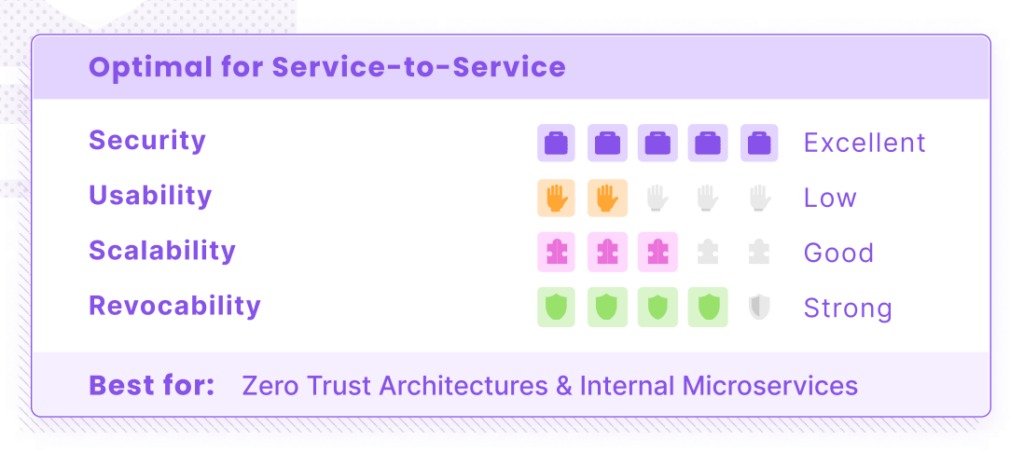
mTLS provides the strongest cryptographic identity for service-to-service authentication. Both the agent and the service prove their identity using certificates, with no shared secrets or bearer tokens. The tradeoff? Operational complexity. You need working PKI, certificate issuance and renewal workflows, and frameworks like SPIFFE/SPIRE to make it manageable.
Best for: High-security internal microservices, zero-trust architectures, environments with existing PKI infrastructure.
API keys and static tokens (convenient but risky)
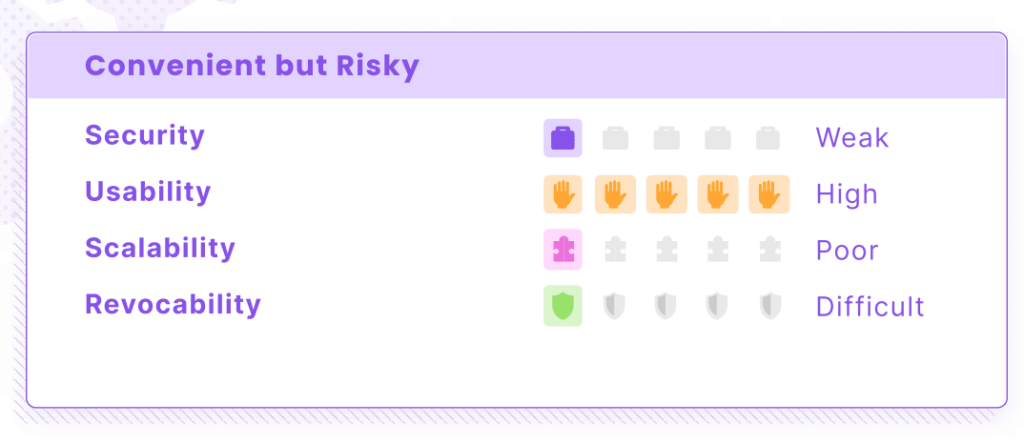
API keys are the oldest and still most common authentication method, and the most dangerous. They’re long-lived, replayable secrets that authenticate the key holder, not the agent or user. They often have no real scope or expiry, and once leaked (via logs, prompt injection, or simple copy-paste errors), they provide indefinite access until someone manually finds and revokes them.
Use only when: The provider offers no better option, and only under strict conditions: vaulted, scoped, unique per agent, with the shortest TTL available.
Hardcoded secrets (do not use)
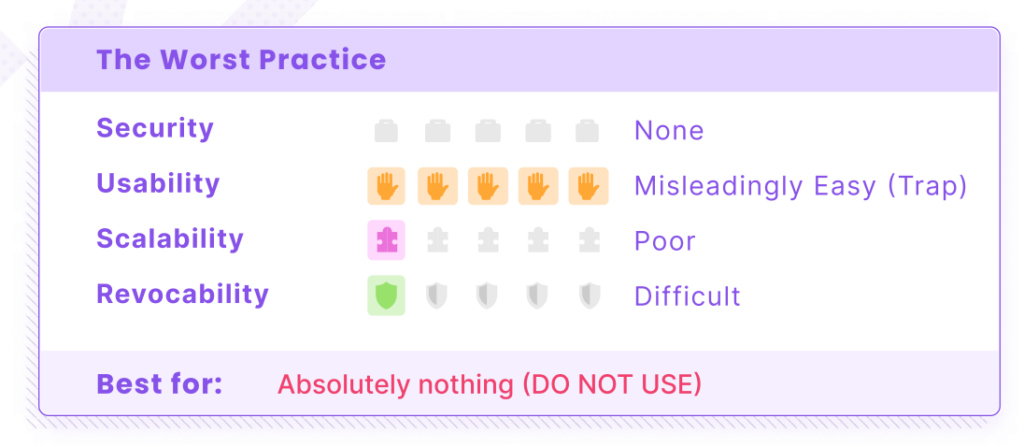
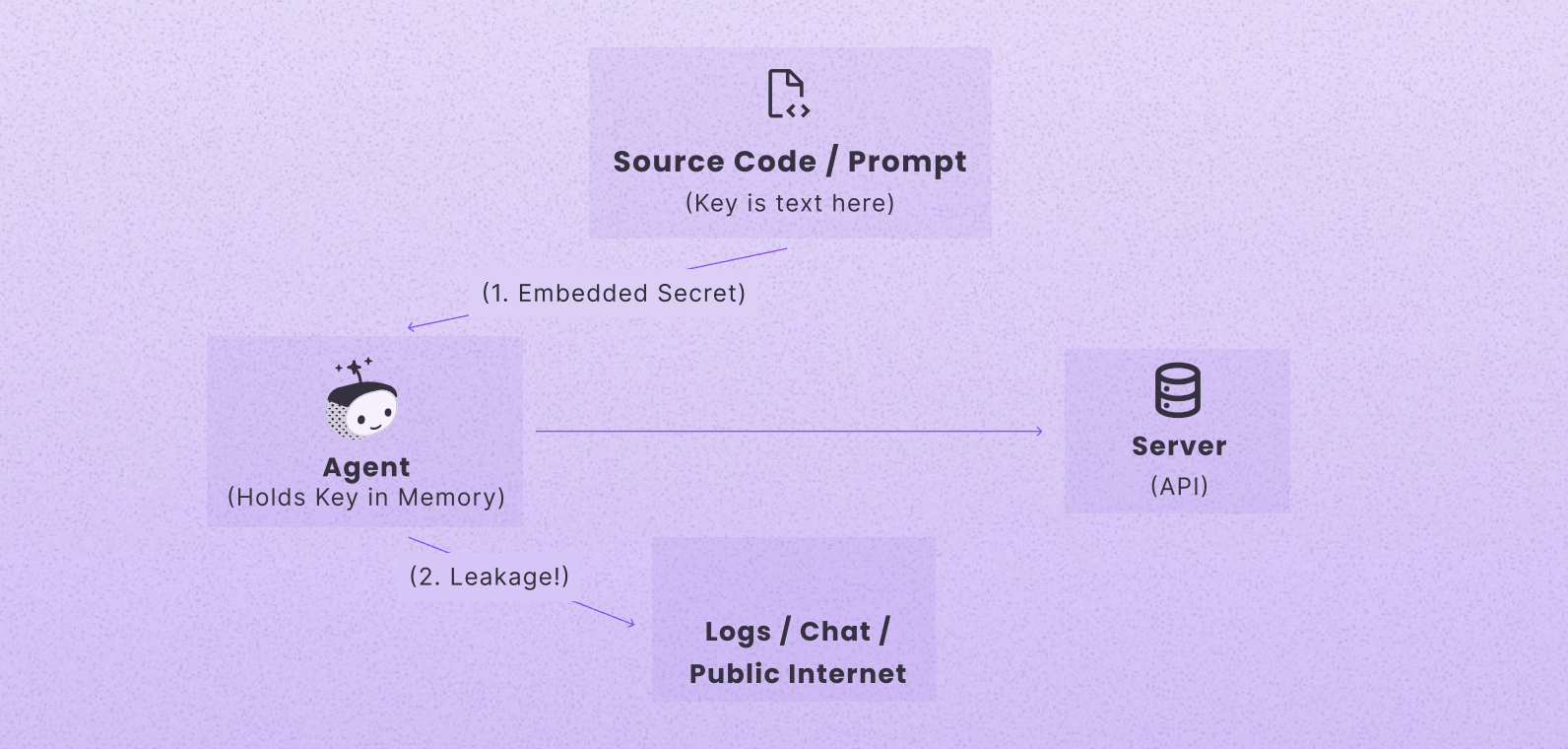
Last and honestly least is the practice of embedding secrets directly into source code, prompts, or configurations, or exposing services with no authentication “so the agent can reach them.” These aren’t patterns to tolerate. They’re architectural bugs. Secrets baked into code end up in logs, tickets, chat histories, and LLM outputs. They accelerate secrets sprawl and create permanent backdoors.
Appropriate for: Nothing. Not even prototypes. Build the right habits from day one!
Environment determines method
There’s no single “best” authentication method for all AI agents. What works in a trusted backend can be dangerous on an unmanaged endpoint. The right approach depends on where your agent runs:
Trusted backend / single cloud: Default to service accounts, workload identities, or mTLS. No static secrets in runtime by design.
Cross-organization & SaaS integrations: Default to OAuth 2.1/OIDC with short-lived tokens. If a vendor supports OAuth, that should be your only allowed method.
Unmanaged endpoints / BYOD: Treat these environments as untrusted. Agents running here should never hold long-lived secrets or refresh tokens. They should call back to a controlled backend that manages credentials.
The job of a CISO or security architect isn’t to pick “the best method” in abstract terms. It’s to standardize which methods are acceptable in which environments and make anything else impossible, not just discouraged.
What’s next
This is the first in our series breaking down the complete authentication landscape for AI agents. Next, we’ll explore the dangerous convenience of API keys and hardcoded secrets: why they remain the most common authentication methods and the critical risks they introduce to AI agent deployments.
For the complete technical comparison, detailed use cases, and a pragmatic roadmap for standardizing authentication across your AI agent ecosystem.
Authenticating AI agents: a practical guide for security architects and CISOs