
Last time, in “Practical Takeaways from OWASP”, we looked at how to design safer agentic architectures. OWASP has just released the OWASP Top 10 for Agentic Applications 2026: a concise risk list focused on real-world failures and exploits in AI agents and multi-agent systems. It ties into the both LLM Top 10 and the Top 10 for Non-Human Identities (NHIs), and it is explicit about one core reality: agents mostly amplify existing vulnerabilities – not creating entirely new ones.
NHIs play a key role in this story. Every meaningful agent is powered by secrets and permissions, from API keys and service accounts to OAuth tokens and personal access tokens. When those NHIs are overprivileged, invisible, or exposed, the risks in the Agentic Top 10 move from theory to incident.

The OWASP Agentic Top 10 in One Minute
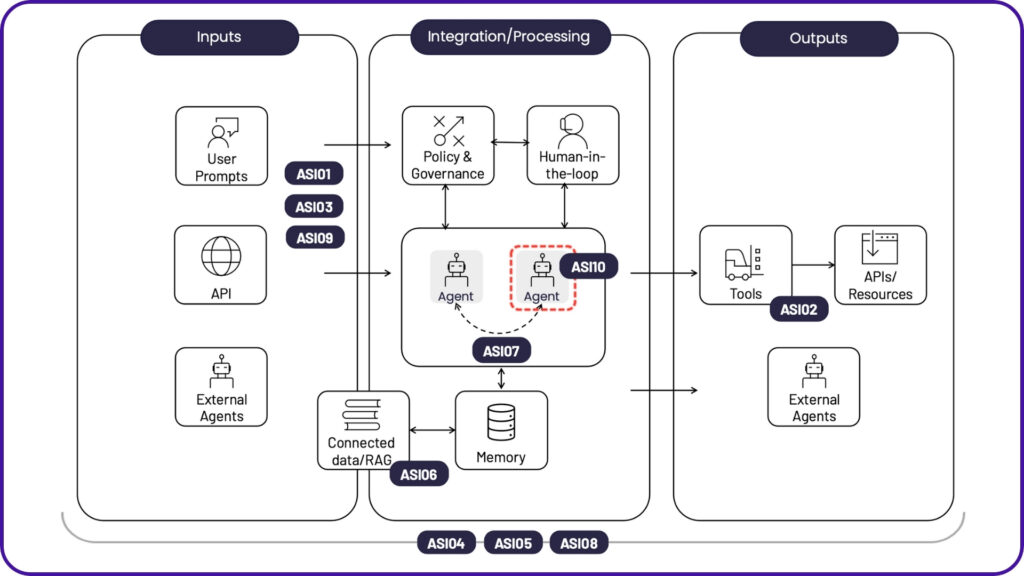
The visual above, taken from OWASP’s new document, places the top 10 across inputs, integration, and outputs of agentic apps, emphasizing that risk is systemic, not just prompt-level.
Here’s the complete list in short, meant for AppSec and platform teams running agents in production:
- Agent Goal Hijack (ASI01) – attackers manipulate natural language inputs, documents, and content so the agents silently change objectives and pursue the attacker’s goal instead of the user’s.
- Tool Misuse and Exploitation (ASI02) – the agents misuse legitimate tools like email, CRM, web browser, DNS, or internal APIs in risky ways, often staying within their granted permissions but deleting data (like the recent incident when a Google AI agent deleted an entire user’s Drive), exfiltrating records, or running destructive commands.
- Identity and Privilege Abuse (ASI03) – agents inherit user sessions, reuse secrets, or rely on implicit cross-agent trust, leading to privilege escalation and actions that cannot be cleanly attributed to a distinct agent identity.
Agentic Supply Chain Vulnerabilities (ASI04) – malicious or compromised models, tools, plugins, MCP servers, or prompt templates introduce hidden instructions and backdoors into agent workflows at runtime. - Unexpected Code Execution (ASI05) – code is executed by agents, exploiting unsafe paths, tools,or unsanctioned package installs to compromise hosts or escape sandboxes.
- Memory and Context Poisoning (ASI06) – persistent memory, embeddings, and RAG stores are infected with malicious or misleading data that bias future reasoning, leak secrets, or slowly shift the agent’s behavior over time.
- Insecure Inter-Agent Communication (ASI07) – comms between agents lack strong authentication, encryption or schema validation, enabling spoofing, replay, protocol downgrade, and “agent-in-the-middle” attacks.
- Cascading Failures (ASI08) – a single poisoned memory entry, bad plan, or compromised app fans out across agents and workflows, turning a localized issue into a wider incident.
- Human-Agent Trust Exploitation (ASI09) – attackers abuse anthropomorphism (humans attributing human characteristics to agents) and authority bias: agents confidently recommend risky actions, fabricate rationales, or socially engineer users into revealing secrets or approving bad changes.
- Rogue Agents (ASI10) – malicious or compromised agents deviate from their intended purpose, appear compliant on the surface, but pursue hidden goals or hijack workflows.
Why This Is Really About Non-Human Identities
The new OWASP document maps the Agentic Top 10 directly to the OWASP Top 10 for Non-Human Identities: over-privileged NHIs, secret exposure, vulnerable third-party NHIs, and long-lived credentials all appear as root causes or amplifiers of agentic risks.

Look at the list through an identity lens:
- Goal hijack (ASI01) matters because the agent already holds powerful credentials.
- Tool misuse (ASI02) matters because tools are wired to cloud and SaaS permissions.
- Identity and privilege abuse (ASI03) is literally about agent sessions, tokens, and roles.
- Memory poisoning (ASI06) becomes critical when memory contains secrets, keys, and tokens.
- Cascading failures (ASI08) amplify because the same NHI is reused across multiple agents and environments.
OWASP is effectively saying: you cannot secure AI agents without securing the non-human identities and secrets that power them.
Where Entro Helps Enterprises Align With the Agentic Top 10
OWASP is vendor-neutral. We are not.
Entro was built for exactly the class of problems that show up again and again in the Agentic Top 10: NHI you don’t know you have, over privileged agents, and exposed long-lived secrets that quickly spread across apps, agents, code, and supply chains.
Preventing Identity and Privilege Abuse (ASI03, ASI02, ASI07)
At the heart of ASI03 is a simple requirement: agents need their own identities (“personas”), with task scoped, time bound permissions and clear auditability, rather than riding on top of human sessions or inherited admin access.
At Entro, we help our customers:
- Discover every NHI behind their agents, from API keys and OAuth tokens to PATs, service accounts, and other secrets across cloud, SaaS, CI/CD, and code.
- Map what each identity can actually do, which agents are using it, and where those permissions violate least privilege.
- Track anomalies over time so you can see when an agent’s behavior start to drift into new environments or higher risk operations.
In practice, that is how our customers implement OWASP’s call for per agent identities, eliminate long lived unused credentials, and complete inventories with strong audit trails for agentic apps.
Limiting Blast Radius (ASI04, ASI06, ASI08)
OWASP is very clear on two points: you need provenance and inventory for the components that feed your agents, and you need the ability to contain and kill compromised elements quickly. Entro focuses on the part most teams struggle to see: what happens when those components expose secrets. When tickets, logs, source code, or tools leak credentials, Entro:
- Identifies the exposed secret and classifies it by type and service – and ties it to a human owner whenever possible.
- Shows every agent, microservice, and workload that depends on it, including cloud blast radius.
- Prioritizes which secrets to rotate first and where to narrow permissions so a single compromised NHI cannot cascade into an ASI08 style failure.
This turns OWASP recommendations on provenance, segmentation, and kill switches into a concrete playbook: you know what to revoke, where, and in which order, instead of guessing in the middle of an incident.
Making Rogue or Hijacked Agents Observable (ASI01, ASI10)
OWASP stresses that agents need comprehensive logging and continuous monitoring of activity, including tool use patterns and deviations from baseline, in order to spot goal hijack and rogue behavior early.
Entro’s NHIDR engine gives security teams a lens from the identity side. By monitoring how NHIs behave across different environments in real time, we can highlight when an agent suddenly:
- Uses a token from an unusual location or environment.
- Calls APIs it has never used before.
- Starts chaining tools or accessing data in ways that do not match its historical profile.
Those are exactly the kind of early indicators you need for ASI01 and ASI10: catching agents whose goals have been quietly shifted, or whose behavior no longer aligns with their declared purpose, before they turn into a full blown incident.
Turning OWASP’s Guardrails Into Practice With Entro
In short, OWASP Agentic Top 10 defines the risks and the guardrails. Entro’s platform gives you the visibility, context, and controls around secrets and NHIs that make those policies enforceable in live, messy, agentic environments.
If you are aligning your AI and agent security program to the OWASP Agentic Top 10 and NHI Top 10, we can help you get there faster and with real-world coverage. Talk to us about how we discover and secure your agents’ secrets and identities, map blast radius, and turn OWASP guidance into concrete controls across your cloud, code, SaaS, and CI/CD stack.