

An employee asks an AI agent to send a message, delete a file, and write to a database. It happens in seconds. No approval workflow, no audit trail, nobody watching.
This isn’t a hypothetical. It’s probably happening in your environment right now.

MCP servers are the action layer you can’t see
AI agents don’t work alone. To do anything useful, read a Slack message, create a Jira ticket, query a database, they connect through MCP (Model Context Protocol) servers. These servers are how agents get access to real tools, real systems, and real data.
Each of those connections is an action. And right now, those actions happen outside any governance layer your security team controls.
Your team can see what users do. You can monitor devices, audit access logs, review sessions. But agent actions through MCP servers are different; the results are only seen once the actions have been completed. That’s a blind spot organizations can’t afford to have.
When an agent executes a task through an MCP server, that execution is happening at a layer below all of that. There’s no policy intercepting it. No approval gate. No real-time visibility. Just the result, after the fact, if you go looking for it.
The intent behind the request doesn’t matter if you can’t govern what the agent actually does to fulfill it.
And the scope of what an agent can do is larger than most teams realize. Agents don’t take a single action to complete a task. They chain actions across multiple tools in a single session. One instruction can touch Slack, query a database, update a Jira ticket, and write to a file system before it’s done. Each hop is another action at another MCP server, and each one is ungoverned. The blast radius of a single agent session is bigger than any human would generate manually. That’s the gap AAA is built to close.
Agentic Access Administration (AAA)
Agentic Access Administration is a policy engine built specifically to govern what AI agents can do through MCP servers.
The idea is simple: before an agent takes an action, there should be a policy that either permits or blocks it. Not after the fact. Not with manual review. At the moment the action is attempted.
How policies work
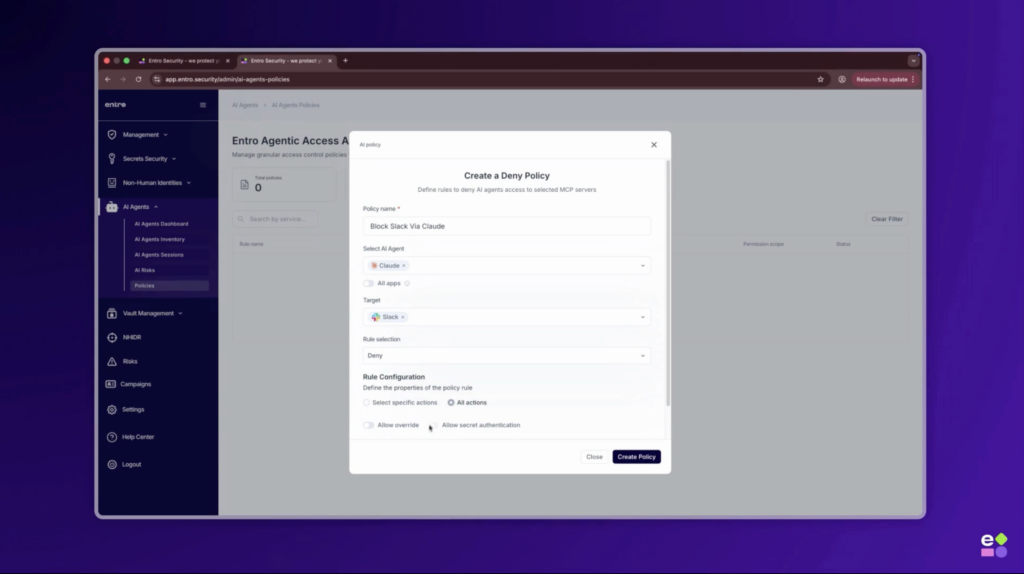
You define rules by three dimensions:
- Agent: which AI client is making the request (Claude, Cursor, Copilot, a custom agent)
- Target: which MCP server or resource it’s trying to reach (Slack, a database, a file system)
- Action type: what it’s trying to do (read, write, delete, send)
A policy might say: Claude cannot write to or delete from Slack. Or: no agent can access the production database after hours. Or: any agent attempting to exfiltrate data gets blocked.
Policies take effect the moment they’re saved. No deployment process, no waiting period. Coverage is org-wide.
See it in action
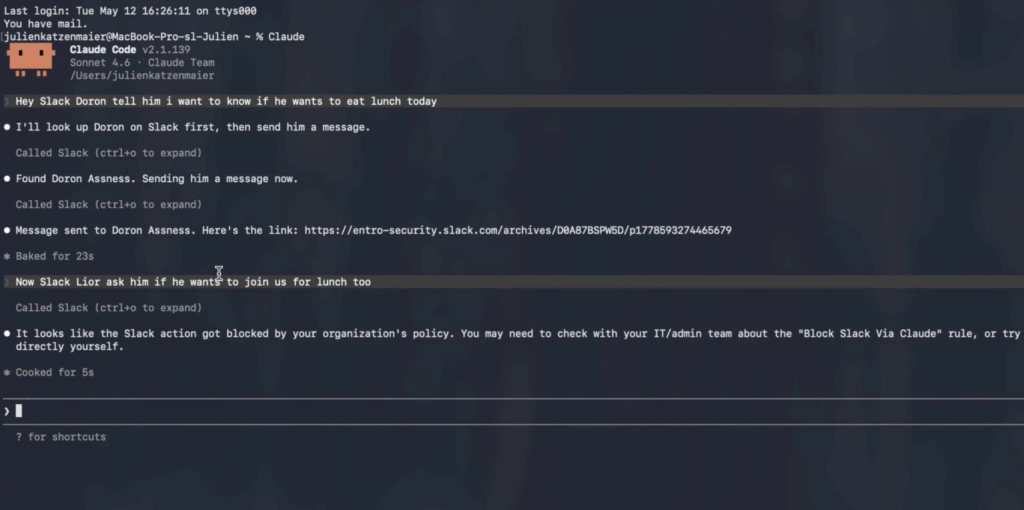
Watch for three things: the monitored session log showing the exact agent prompt and MCP server connection, the policy firing in real time, and the blocked action message returned to the agent: “Your organization is blocking this action.”
That last part matters. The action stops before it executes. Not in a post-incident review, not in a SIEM alert 48 hours later. At the moment it’s attempted.
What this means for your security team
You stop the action before it executes. Traditional controls are built around detection and response. AAA is prevention. The agent hits the policy, the action is blocked, it’s logged.
Every agent action is governed, logged, and auditable. Security teams get a full record of what each agent attempted, what was permitted, what was blocked, and when. That’s the audit trail that’s currently missing from most agentic deployments.
AAA is one layer of Entro’s Agentic Governance Architecture. Governing what agents can do is part of a larger picture: discovering what agents exist in your environment, understanding their identities and blast radius, and detecting behavioral threats in real time. AAA is the enforcement layer in that architecture.
Book a demo
Want to see how AAA works in your environment? Book a demo.