Key Takeaways
- Data at rest is stored, static data; data in transit is data actively moving across a network. Both require distinct but complementary security strategies.
- In 2025, the global average cost of a data breach reached $4.44 million — making encryption of both data states a non-negotiable baseline.
- Encryption (AES for stored data, TLS/SSL for transmitted data), access controls, and DLP are the three pillars of protecting data in either state.
- Non-human identities (NHIs) like API keys, tokens, and service accounts are major carriers of sensitive data in transit and a growing attack vector.
- Entro Security secures the secrets and AI agents that handle sensitive data across both states, providing full lifecycle visibility and real-time detection.
What is Data at Rest vs. Data in Transit
Data at rest refers to data that is not actively moving from one location to another, such as data stored on a hard drive, in a database, or in a cloud storage service. This data is generally considered to be static, waiting to be accessed or modified. Securing data at rest often involves encryption, access controls, and physical security measures to prevent unauthorized access.
Conversely, data in transit, also known as data in motion, is data actively moving across a network, whether internal or external. This includes data being transmitted between servers, between a user’s device and a server, or across the internet. Because data in transit is vulnerable to interception and eavesdropping, it requires strong security measures such as encryption using protocols like Transport Layer Security (TLS) or Secure Sockets Layer (SSL) to ensure confidentiality and integrity during transmission. Data loss prevention (DLP) strategies are also crucial.
Synonyms
- Data at Rest: Stored data, inactive data, persistent data
- Data in Transit: Data in motion, data in flight, data being transmitted
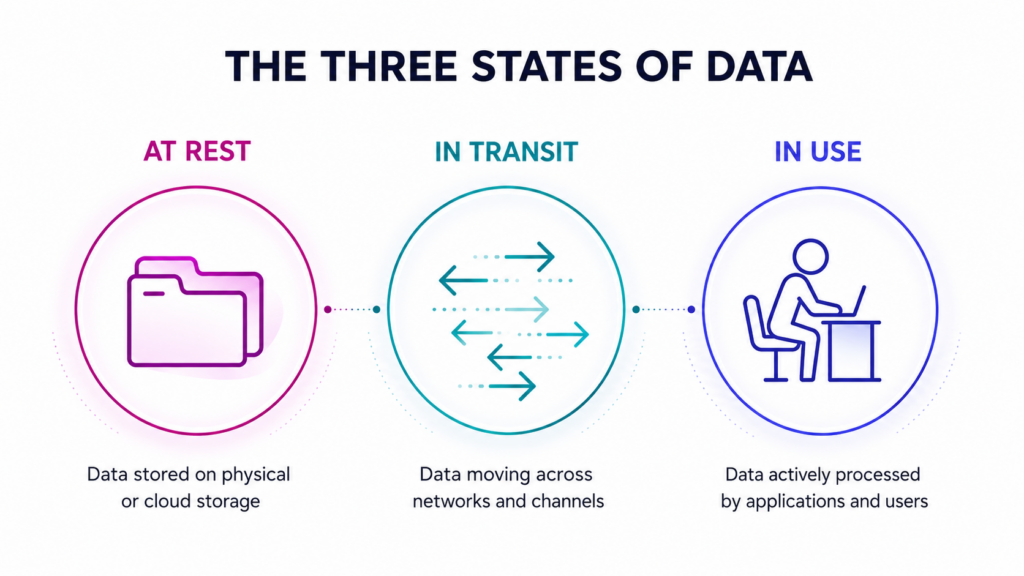
Data at Rest vs. Data in Transit: Side-by-Side Comparison
| Attribute | Data at Rest | Data in Transit |
|---|---|---|
| Definition | Stored, non-moving data | Data actively moving across a network |
| Location | Hard drives, databases, cloud storage, backups | Network channels, APIs, email, web traffic |
| Primary threat | Unauthorized access, insider threats, physical theft | Interception, eavesdropping, man-in-the-middle attacks |
| Encryption method | AES (full-disk, database, file-level) | TLS/SSL, VPNs, HTTPS |
| Access control focus | Role-based access control (RBAC), MFA | Secure APIs, authenticated sessions, DLP monitoring |
| Compliance relevance | GDPR, HIPAA, PCI DSS storage requirements | GDPR, HIPAA, PCI DSS transmission requirements |
Data at Rest vs. Data in Transit Examples
Data at Rest Examples:
- Databases containing customer information.
- Files stored on a company’s file server.
- Backups of critical systems stored offline.
- Archived emails in a mail server.
- Data stored on employee laptops and mobile devices.
Data in Transit Examples:
- Email messages sent across the internet.
- Data being transferred between a web server and a client browser.
- Files being uploaded to a cloud storage service.
- Data synchronized between mobile devices and a central server.
- API calls made between microservices.
Why the Distinction Matters
Understanding the difference between data at rest and data in transit is crucial for implementing appropriate security controls. The security measures required for each state differ significantly. A failure to properly secure either state can result in data breaches, compliance violations, and serious reputational damage.
One often-overlooked dimension of this distinction is the role of non-human identities. NHIs — including API keys, OAuth tokens, service accounts, and machine credentials — constantly carry sensitive data in transit as they authenticate between systems. According to Entro Labs’ H1 2025 NHI & Secrets Risk Report, NHI sprawl grew 44% year-over-year, with nearly half of secret exposures occurring outside of code repositories. Every one of those NHIs is a potential vector for exposed data in motion.
Benefits of Data at Rest vs. Data in Transit
Implementing robust security measures for both data at rest and data in transit yields numerous benefits:
- Data Protection: Reduces the risk of unauthorized access, theft, or modification of sensitive data.
- Compliance: Helps organizations meet regulatory requirements such as GDPR, HIPAA, and PCI DSS.
- Reputation Management: Protects the organization’s reputation and maintains customer trust.
- Intellectual Property Protection: Safeguards valuable intellectual property from competitors and malicious actors.
- Operational Efficiency: Ensures business continuity by preventing data loss and minimizing downtime.
- Cost Savings: Reduces the financial impact of data breaches, including fines, legal fees, and remediation costs.
Data Security Strategies
Effective data security relies on a layered approach, incorporating various strategies to protect data at rest and in transit. This includes implementing strong encryption algorithms, access controls, network segmentation, and continuous monitoring.
Challenges With Data at Rest vs. Data in Transit
Securing data at rest and in transit presents unique challenges. Organizations must address these challenges to maintain a strong security posture. One challenge involves balancing usability with security. Overly restrictive security measures can hinder productivity and make it difficult for authorized users to access the data they need. Another significant hurdle is the evolving threat landscape, requiring continuous adaptation and improvement of security measures. New vulnerabilities and attack techniques emerge constantly, demanding that organizations stay informed and proactive in their security efforts. Addressing the prioritization of cloud remediation is often crucial.
Encryption Techniques
Encryption is a cornerstone of data security, both at rest and in transit. Different encryption techniques are used depending on the specific requirements and context. At rest, full disk encryption, database encryption, and file-level encryption are common methods. In transit, protocols like TLS/SSL provide encryption for network communications. The strength of the encryption algorithm and the key management practices are critical to the effectiveness of the encryption.
Encryption for Data at Rest
For data at rest, Advanced Encryption Standard (AES) is widely used due to its strength and efficiency. AES can be implemented in hardware or software and is supported by many operating systems and applications. Proper key management is essential to ensure that encrypted data remains protected. Keys should be stored securely and rotated regularly.
Encryption for Data in Transit
For data in transit, TLS/SSL is the dominant protocol for securing web traffic and other network communications. TLS/SSL uses a combination of symmetric and asymmetric encryption to establish a secure connection between the client and server. The protocol also provides authentication and integrity checks to prevent tampering with the data. The strength of the TLS/SSL configuration, including the choice of cipher suites and key lengths, is critical to its effectiveness.
Access Controls and Authentication
Access controls and authentication mechanisms are essential for limiting access to sensitive data. These controls ensure that only authorized users can access data at rest and that data in transit is protected from unauthorized interception. Multi-factor authentication (MFA) adds an extra layer of security by requiring users to provide multiple forms of authentication, such as a password and a code from their mobile device. Role-based access control (RBAC) assigns permissions based on a user’s role within the organization, ensuring that users only have access to the data they need to perform their job duties.
Role-Based Access Control (RBAC)
RBAC simplifies the management of access permissions by assigning roles to users and granting permissions based on those roles. This approach reduces the risk of accidental or malicious access to sensitive data. RBAC also makes it easier to audit access permissions and ensure compliance with regulatory requirements.
Multi-Factor Authentication (MFA)
MFA significantly enhances security by requiring users to provide multiple forms of authentication. This makes it much more difficult for attackers to gain unauthorized access to sensitive data, even if they have stolen a user’s password. MFA can be implemented using various methods, such as one-time passwords (OTPs), biometric authentication, and hardware security keys.
Data Loss Prevention (DLP)
Data Loss Prevention (DLP) solutions help organizations prevent sensitive data from leaving their control. DLP systems monitor data in transit and at rest, looking for patterns that indicate sensitive information being transferred or stored inappropriately. DLP policies can be configured to block or quarantine suspicious data transfers, alert administrators to potential security incidents, and enforce compliance with data protection regulations.
DLP for Data at Rest
DLP for data at rest involves scanning storage locations for sensitive data and applying appropriate security controls. This can include encrypting sensitive files, redacting sensitive information, or moving sensitive data to a more secure location. DLP systems can also be configured to prevent users from storing sensitive data in unauthorized locations, such as personal cloud storage accounts. Discovering and classifying sensitive data is a key component.
DLP for Data in Transit
DLP for data in transit involves monitoring network traffic for sensitive data being transmitted over the internet or internal network. This can include monitoring email traffic, web traffic, and file transfers. DLP systems can be configured to block or quarantine suspicious data transfers, alert administrators to potential security incidents, and enforce compliance with data protection regulations.
Network Security
Network security measures are essential for protecting data in transit from unauthorized access and interception. Firewalls, intrusion detection systems (IDS), and intrusion prevention systems (IPS) can help prevent attackers from gaining access to the network and intercepting data. Network segmentation can also be used to isolate sensitive data and limit the impact of a security breach.
Firewalls
Firewalls act as a barrier between the organization’s network and the outside world, preventing unauthorized access to the network. Firewalls can be configured to block specific types of traffic, such as traffic from known malicious IP addresses or traffic on specific ports. Firewalls can also be used to enforce network access policies and prevent users from accessing unauthorized websites or services.
Intrusion Detection and Prevention Systems
IDS and IPS systems monitor network traffic for malicious activity and attempt to block or prevent attacks. IDS systems detect suspicious activity and alert administrators to potential security incidents. IPS systems go a step further and attempt to block or prevent attacks from succeeding. IDS and IPS systems can be configured to detect a wide range of attacks, including malware infections, denial-of-service attacks, and brute-force attacks.
Physical Security
Physical security measures are also important for protecting data at rest. This includes securing physical access to data centers, servers, and other storage locations. Physical security controls can include security cameras, access control systems, and security guards. Proper environmental controls, such as temperature and humidity monitoring, are also important for preventing data loss due to hardware failures.
Importance of Regular Audits
Regular security audits are crucial for identifying vulnerabilities and ensuring that security controls are effective. Audits should cover both data at rest and data in transit, and should be conducted by qualified security professionals. Audit findings should be used to improve security controls and address any identified vulnerabilities. NHIS compliance and other security frameworks can provide a structured approach to auditing.
Staying Compliant
Many industries are subject to regulations that govern the protection of sensitive data. Compliance with these regulations requires organizations to implement appropriate security controls for both data at rest and data in transit. Failure to comply with these regulations can result in significant fines and legal penalties. Examples of regulations include GDPR, HIPAA, and PCI DSS.
Data Security Strategies: A Layered Approach
| Security Layer | Protects Data at Rest | Protects Data in Transit |
|---|---|---|
| Encryption | AES (full-disk, file, database) | TLS/SSL, VPN, HTTPS |
| Access Control | RBAC, MFA, least-privilege | API authentication, session tokens |
| DLP | Storage scanning, policy enforcement | Traffic monitoring, transfer blocking |
| Network Security | Segmentation to isolate stored data | Firewalls, IDS/IPS |
| Auditing | Periodic scanning and compliance checks | Real-time monitoring and alerts |
| NHI Security | Secrets vaulting, token lifecycle | Credential rotation, anomaly detection |
How This Applies to Entro
Modern enterprises don’t just have humans accessing sensitive data — they have thousands of AI agents, service accounts, API integrations, and automated workflows doing it constantly. These non-human identities (NHIs) are responsible for an enormous volume of the data that moves in transit and touches data at rest every day.
Entro Security is the enterprise security platform for AI agents and non-human identities. Entro ensures that every secret (API key, token, credential, certificate) used to access or transmit sensitive data is properly vaulted, encrypted, and governed throughout its lifecycle.
Specifically, Entro helps organizations:
- Discover and classify every NHI and secret across clouds, CI/CD pipelines, code repositories, SaaS apps, and collaboration tools — so you know what is touching data at rest
- Detect anomalies in transit through NHIDR (Non-Human Identity Detection and Response), which monitors NHI behavior in real time and alerts on unusual access patterns that could signal credential misuse or data exfiltration
- Enforce least-privilege for every machine identity, reducing the blast radius of a compromised credential
- Secure Agentic AI deployments, ensuring that AI agents only access the data they are authorized to touch and that the secrets they carry are encrypted both at rest and in transit
As AI agent adoption grows and the NHI-to-human identity ratio continues to widen (currently growing at 44% year-over-year), securing the credentials these agents carry becomes inseparable from securing the data itself.
People Also Ask
What are the key differences in securing data at rest versus data in transit?
Securing data at rest focuses on protecting stored data through methods like encryption, access controls, and physical security. Securing data in transit concentrates on safeguarding data as it moves across networks, often using encryption protocols like TLS/SSL, VPNs, and secure APIs.
How does encryption protect data at rest and data in transit?
Encryption transforms data into an unreadable format using an algorithm. For data at rest, it protects data stored on devices or in databases. For data in transit, it protects data during transmission over networks, preventing unauthorized interception.
What role does access control play in securing data at rest?
Access control limits who can access, view, or modify data at rest. It ensures that only authorized individuals or systems can interact with sensitive information, reducing the risk of unauthorized access and data breaches.
What is the purpose of Data Loss Prevention (DLP) in protecting data?
DLP systems monitor and prevent sensitive data from leaving the organization’s control, whether the data is at rest (stored) or in transit (being transmitted). They help ensure that confidential information is not accidentally or maliciously leaked.
How can network segmentation help secure data in transit?
Network segmentation divides a network into smaller, isolated segments. This limits the impact of a security breach by preventing attackers from moving laterally across the entire network and accessing sensitive data in transit.
What is the importance of regular security audits for data security?
Regular security audits identify vulnerabilities and ensure that security controls are effective. They provide a systematic review of security measures and help organizations stay compliant with regulations and industry best practices.