Key Takeaways
- A TLS handshake is the cryptographic negotiation process that establishes a secure, authenticated connection between a client and a server before any data is transmitted.
- TLS 1.3 is now the dominant standard: as of June 2025, 75.3% of the top 150,000 websites support it, offering faster handshakes and stronger security than TLS 1.2.
- Over 71% of malware now travels over encrypted (HTTPS) connections, meaning TLS alone is no longer sufficient — what’s operating within encrypted channels matters just as much.
- TLS certificates are non-human identities (NHIs). Their lifecycle — issuance, rotation, expiry, and revocation — must be actively managed and monitored.
- Entro’s platform discovers, contextualizes, and governs TLS certificates and the AI agents and NHIs that depend on them, preventing certificate-related outages and credential abuse.
What is TLS Handshake
TLS Handshake, or Transport Layer Security Handshake, is a crucial process that establishes a secure connection between a client (like a web browser) and a server. It’s the initial negotiation phase in a TLS connection, ensuring confidentiality and integrity of the data exchanged. This complex cryptographic exchange authenticates the server (and optionally the client), negotiates encryption algorithms, and establishes shared secrets used for secure communication. Understanding the intricacies of the TLS Handshake process is vital for any security professional.
Synonyms
- SSL Handshake (though technically older, often used interchangeably)
- Secure Connection Establishment
- Cryptographic Handshake
- TLS Negotiation
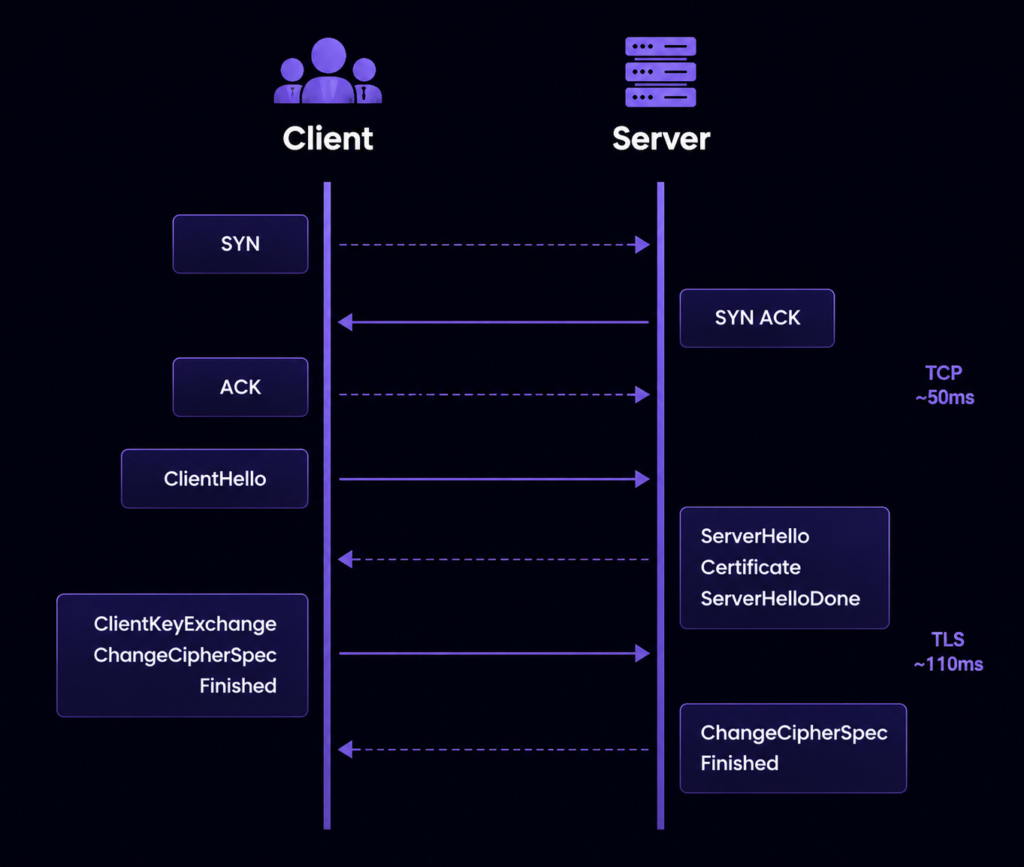
TLS Handshake Examples
Imagine you are accessing your online banking portal. When you type the website address and press enter, your browser initiates a TLS Handshake with the bank’s server. This handshake ensures that your login credentials and financial data are encrypted and protected from eavesdropping. Another example is when an email client securely connects to a mail server to send or receive emails. The “Performing TLS Handshake” message you sometimes see in your browser status bar is a direct indication of this process happening in real time. Even when interacting with APIs or other web services, a TLS Handshake plays a pivotal role in securing the data transfer.
The Process: A Simplified Overview
The TLS Handshake involves a series of messages exchanged between the client and server. It starts with the client sending a “Client Hello” message, which includes the TLS version, supported cipher suites, and a random number. The server responds with a “Server Hello” message, choosing the TLS version and cipher suite to be used. The server also sends its digital certificate for authentication. The client verifies the server’s certificate and, if successful, generates a pre-master secret, encrypts it using the server’s public key, and sends it to the server. Both client and server then use the pre-master secret to derive a master secret, which is then used to generate symmetric keys for encrypting the actual data transmitted during the session. The risk mitigation in transit relies heavily on the strength of this handshake.
| Step | Message | What Happens |
|---|---|---|
| 1 | ClientHello | Client sends supported TLS versions, cipher suites, and a random value |
| 2 | ServerHello | Server selects TLS version, cipher suite, and sends its own random value |
| 3 | Certificate | Server presents its digital certificate (signed by a trusted CA) |
| 4 | Key Exchange | Client and server derive a shared pre-master secret (using ECDHE or similar) |
| 5 | Finished | Both sides confirm the handshake succeeded with encrypted “Finished” messages |
| 6 | Secure Session | Encrypted communication begins using the negotiated session keys |
In TLS 1.3, steps are combined to reduce the process to a single round trip (1-RTT), down from two in TLS 1.2 — significantly improving connection speed without sacrificing security.
TLS 1.2 vs. TLS 1.3: Key Differences
| Feature | TLS 1.2 | TLS 1.3 |
|---|---|---|
| Round trips to complete handshake | 2-RTT | 1-RTT (0-RTT for resumption) |
| Forward secrecy | Optional | Mandatory |
| Supported cipher suites | Many (including weak ones) | Streamlined to strong-only |
| Session resumption | Session IDs / tickets | PSK (Pre-Shared Keys) |
| Post-quantum readiness | No | Yes (hybrid key exchange) |
| Adoption (June 2025) | Still widely used | 75.3% of top 150K websites |
Major cloud platforms including Azure ended support for TLS 1.0 and 1.1 in 2024, and using TLS 1.3 is now considered best practice. By late 2025, over 50% of Cloudflare’s HTTPS traffic was using a hybrid post-quantum key exchange within TLS 1.3.
Benefits of TLS Handshake
The primary benefit of a TLS Handshake is the establishment of a secure communication channel, ensuring the confidentiality, integrity, and authenticity of data transmitted between a client and a server. Without it, sensitive information like passwords, credit card details, and personal data would be vulnerable to interception and manipulation. A successful handshake guarantees that the data is encrypted using strong cryptographic algorithms, preventing unauthorized access. The handshake also validates the identity of the server, protecting against man-in-the-middle attacks. This secure foundation is crucial for maintaining trust and security in online transactions and communications.
Securing Sensitive Data
A robust TLS Handshake protects sensitive data from being intercepted and read by malicious actors. This is particularly important for applications that handle financial transactions, personal information, or other confidential data. Encryption ensures that even if an attacker intercepts the data stream, they won’t be able to decipher the information without the correct decryption keys. This layer of security is essential for maintaining user privacy and preventing data breaches.
Ensuring Server Authentication
The TLS Handshake process includes server authentication, which verifies that the client is indeed communicating with the intended server and not an imposter. The server presents its digital certificate, which is issued by a trusted Certificate Authority (CA), to the client. The client then verifies the certificate’s validity and authenticity. This process prevents man-in-the-middle attacks, where an attacker intercepts the communication and impersonates the server to steal sensitive information. By verifying the server’s identity, the TLS Handshake ensures that the client is communicating with the legitimate server.
Maintaining Data Integrity
Beyond confidentiality and authentication, TLS Handshake also ensures data integrity. During the handshake, the client and server agree on a cryptographic hash function to be used for verifying the integrity of the data transmitted. This hash function generates a unique fingerprint of the data, which is sent along with the data itself. The recipient can then recalculate the hash and compare it to the received hash. If the hashes match, it confirms that the data has not been tampered with during transmission. This integrity check is crucial for preventing data corruption and ensuring that the received data is exactly what was sent.
Challenges With TLS Handshake
While TLS Handshake provides essential security, it also presents certain challenges. One significant challenge is the overhead associated with the handshake process itself, which can impact performance and latency, especially for frequently accessed resources. Another challenge is the complexity of configuring and managing TLS certificates, which can be time-consuming and error-prone. Additionally, vulnerabilities in TLS protocols and implementations can expose systems to security risks, requiring constant vigilance and timely patching. Certain “TLS Handshake Failed” errors can be difficult to diagnose, requiring advanced debugging techniques.
Performance Overhead
The TLS Handshake process adds overhead to the communication between a client and a server. This overhead includes the time required to exchange messages, perform cryptographic operations, and verify certificates. While the overhead is typically small, it can become significant for high-traffic websites and applications. Optimizing the handshake process, such as using TLS session resumption or TLS 1.3, can help mitigate this performance overhead. Considerations of reducing round trips are vital for maximizing throughput.
Certificate Management
Managing TLS certificates can be a complex and time-consuming task. Certificates need to be obtained from a trusted Certificate Authority (CA), installed on the server, and renewed regularly. Expired certificates can lead to connection errors and security vulnerabilities. Additionally, organizations need to keep track of their certificates and ensure that they are properly configured. Automating certificate management can help streamline this process and reduce the risk of errors.
Protocol Vulnerabilities
TLS protocols and implementations have been found to have vulnerabilities over time. These vulnerabilities can be exploited by attackers to compromise the security of the connection. Examples of past TLS vulnerabilities include Heartbleed, POODLE, and BEAST. Staying up-to-date with the latest security patches and using secure TLS configurations is crucial for mitigating these risks. Regular security audits and penetration testing can help identify and address potential vulnerabilities.
Encrypted Threats
The security that TLS provides can also obscure threats. The WatchGuard Q1 2025 Internet Security Report found that 71% of malware now arrives over encrypted connections — hiding within valid HTTPS traffic and bypassing legacy inspection tools. TLS ensures the channel is secure; it says nothing about whether the traffic itself is benign.
Mitigating TLS Handshake Vulnerabilities
Several strategies can be employed to mitigate vulnerabilities associated with the TLS Handshake. Regularly updating TLS libraries and protocols to the latest versions is crucial for addressing known security flaws. Implementing strong cipher suites and disabling outdated or weak algorithms can further enhance security. Proper certificate management practices, including using short-lived certificates and automating certificate renewal, can reduce the risk of certificate-related issues. Additionally, enabling TLS features like OCSP stapling and HTTP Strict Transport Security (HSTS) can improve security and performance. Understanding safeguarding the digital world starts with these fundamentals.
Staying Up-to-Date
Keeping TLS libraries and protocols up-to-date is essential for addressing known security vulnerabilities. New vulnerabilities are discovered regularly, and security patches are released to fix them. Failing to apply these patches can leave systems vulnerable to attack. Organizations should establish a process for regularly monitoring security advisories and applying updates promptly. Automated patching tools can help streamline this process.
Strong Cipher Suites
Choosing strong cipher suites is crucial for ensuring the security of TLS connections. Cipher suites are sets of cryptographic algorithms that are used to encrypt and decrypt data. Outdated or weak cipher suites can be vulnerable to attack. Organizations should disable weak cipher suites and prioritize strong, modern algorithms such as AES-GCM and ChaCha20-Poly1305. Tools like SSL Labs’ SSL Server Test can help analyze the security of TLS configurations and identify weak cipher suites.
Proper Certificate Management
Proper certificate management practices are essential for maintaining the security of TLS connections. This includes obtaining certificates from trusted Certificate Authorities (CAs), installing them correctly on servers, and renewing them before they expire. Using short-lived certificates can reduce the risk of certificate-related attacks. Automating certificate renewal can help prevent expired certificates, which can lead to connection errors and security vulnerabilities. Techniques that consider non-human identities are also applicable here.
Optimizing TLS Handshake Performance
Several techniques can be used to optimize TLS Handshake performance. TLS session resumption allows clients to reuse previously established session keys, reducing the overhead of the full handshake process. TLS False Start allows clients to begin sending data before the handshake is fully complete, improving perceived performance. HTTP/2 protocol uses connection multiplexing, which allows multiple requests to be sent over a single TLS connection, reducing the number of handshakes required. Careful selection of cryptographic algorithms can also contribute to faster handshakes, choosing computationally less intensive algorithms when appropriate. Correctly tuning the server configurations can also improve responsiveness during the TLS negotiation.
How TLS Handshake Security Applies to Entro
TLS certificates are non-human identities. Every service account, AI agent, microservice, and application that initiates a TLS connection is doing so using machine credentials — and those credentials carry the same risks as any other secret: they can expire, be misconfigured, be stolen, or be used by unauthorized parties.
Entro’s platform is purpose-built to secure this layer. It discovers TLS certificates, API keys, tokens, and service accounts across your entire environment — vaults, cloud, CI/CD, code repositories, and chat systems — and builds a contextualized inventory tied to ownership, permissions, and risk posture.
As enterprises increasingly deploy agentic AI systems, this problem compounds. AI agents autonomously initiate connections, call APIs, and operate at machine speed — all via TLS-protected channels backed by machine identities. Without visibility into what those agents are doing and what credentials they’re using, the attack surface grows silently.
Entro’s NHIDR™ (Non-Human Identity Detection & Response) engine monitors for suspicious activity around these identities in real time: certificates accessed from unexpected locations, unusual rotation patterns, or credentials used outside their intended scope. When an anomaly is detected, Entro can trigger automated remediation — rotating credentials, revoking access, or alerting the responsible team.
For security teams managing TLS at scale, Entro provides:
- Full inventory of all certificates and machine identities across the environment
- Ownership attribution — knowing who is responsible for each certificate
- Lifecycle management — automated rotation and renewal workflows
- Real-time detection of anomalous usage via NHIDR™
- Governance for AI agents — visibility into what credentials agentic workflows are using and whether those credentials are behaving as expected
People Also Ask
Q1: What is the difference between SSL and TLS?
SSL (Secure Sockets Layer) is the older protocol, while TLS (Transport Layer Security) is its successor. While the terms are often used interchangeably, TLS is more secure and offers better cryptographic algorithms. Most modern systems use TLS, but the term SSL is still widely recognized.
Q2: What are cipher suites?
Cipher suites are sets of cryptographic algorithms that are used during the TLS Handshake to negotiate the encryption and authentication methods for a secure connection. A cipher suite typically includes algorithms for key exchange, encryption, and message authentication code (MAC).
Q3: How does TLS Handshake protect against man-in-the-middle attacks?
TLS Handshake protects against man-in-the-middle attacks by verifying the identity of the server through digital certificates. The client validates the server’s certificate by checking its signature with a trusted Certificate Authority (CA). This ensures that the client is communicating with the legitimate server and not an imposter attempting to intercept the connection. Some instances discussed on social media highlight the importance of valid certs.
What is forward secrecy and why does it matter?
Forward secrecy means that each TLS session uses a unique, ephemeral key that is discarded after the session ends. Even if a server’s long-term private key is later compromised, past sessions cannot be decrypted. TLS 1.3 mandates forward secrecy; in TLS 1.2, it was optional.
What is TLS session resumption?
Session resumption lets a client reuse previously negotiated session parameters to establish a new connection without a full handshake. In TLS 1.3, this is done with Pre-Shared Keys (PSK) and can even allow 0-RTT connections for returning clients, improving performance significantly.
How do AI agents affect TLS certificate management?
Agentic AI systems make autonomous API calls, each of which requires a valid TLS handshake backed by a machine identity. As these agents proliferate, the number of certificates and credentials in use grows rapidly — often faster than security teams can track manually. Platforms like Entro provide automated discovery, governance, and anomaly detection for the NHIs that AI agents depend on.