Key Takeaways
- Blast radius measures how far damage from a security breach can spread across systems, data, and business operations.
- Non-human identities (NHIs) dramatically amplify blast radius — over-privileged or unrotated credentials give attackers a wide-open attack surface.
- According to Entro Labs H1 2025 research, cloud-native environments now average 144 NHIs for every human identity, making blast radius management a top priority.
- Strategies to reduce blast radius include least-privilege access, network segmentation, Zero Trust architecture, and continuous NHI lifecycle management.
- Entro’s platform is purpose-built to help security teams understand and shrink the blast radius of every NHI and secret in their environment.
What is Blast Radius in Cybersecurity
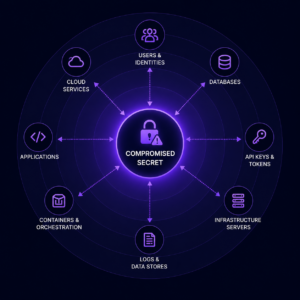
In cybersecurity, blast radius refers to the potential impact or scope of damage resulting from a security breach or system failure. It essentially defines how far-reaching the consequences of a vulnerability exploitation can be, measuring the extent to which an incident can affect systems, data, and overall business operations. A well-contained incident response plan will aim to minimize the blast radius, preventing lateral movement and escalation.
The concept is borrowed from other fields, such as software engineering and even construction, where it describes the area affected by an explosion or failure. In cybersecurity, however, it extends beyond physical damage to include data loss, system unavailability, reputational harm, and financial repercussions. The goal of any security architecture is to reduce the blast radius, ensuring that any single point of failure doesn’t cascade into a widespread disaster.
Understanding and mitigating the blast radius is crucial for risk management and incident response. It allows organizations to prioritize security measures, implement robust containment strategies, and develop effective recovery plans. By limiting the potential impact of a security incident, organizations can minimize disruption, protect critical assets, and maintain business continuity. Properly defining the attack surface is key to understanding the potential scope of impact.
Synonyms
- Impact Radius
- Scope of Impact
- Contamination Zone
- Damage Footprint
- Attack Surface
Blast Radius in Cybersecurity: Real-World Examples
SQL Injection & Database Access Consider a web server compromised through a SQL injection vulnerability. If that server has direct access to a sensitive customer database, the blast radius extends to data theft, identity fraud, and legal liability. Proper segmentation between the server and database would contain the breach to the server alone.
Phishing & Privileged Workstations A phishing attack that compromises an employee with administrative privileges could give an attacker access to the entire network — enabling privilege escalation, malware installation, and data exfiltration. With limited access controls and endpoint detection in place, the blast radius shrinks to just that single workstation.
Vulnerable Open-Source Libraries A critical vulnerability in a widely-used open-source library integrated across many applications can produce an enormous blast radius, potentially granting attackers access to dozens of systems simultaneously. Regular vulnerability scanning is essential to catching these exposures before they’re exploited.
Non-Human Identity Compromise One of the most significant blast radius risks today involves NHIs. When an API key, service account, or OAuth token with broad permissions is compromised, attackers can silently access cloud resources, escalate privileges, and exfiltrate data at machine speed — with little to no audit trail. According to recent research, 60% of NHIs are being overused (the same credential shared across multiple applications), meaning a single compromised token can affect many services at once.
Blast Radius Risk Factors: A Comparison
| Risk Factor | Low Blast Radius | High Blast Radius |
|---|---|---|
| Access permissions | Least-privilege, scoped | Over-privileged, broad |
| Network segmentation | Microsegmented zones | Flat network |
| NHI credential rotation | Regular rotation enforced | Unrotated for 12+ months |
| Shared credentials | One NHI per application | Same NHI across many apps |
| Orphaned accounts | Deprovisioned promptly | Stale, active after owner leaves |
| Monitoring | Real-time anomaly detection | No behavioral baselines |
Network Segmentation and Blast Radius
Network segmentation is a key strategy for reducing the blast radius. By dividing the network into isolated zones, organizations can limit the lateral movement of attackers and prevent them from accessing sensitive resources. For instance, critical infrastructure systems should be segmented from the general corporate network to minimize the risk of disruption in the event of a cyberattack.
Implementing microsegmentation takes this approach further, isolating individual workloads and applications. This granular level of control makes it even more difficult for attackers to move laterally and compromise multiple systems. Microsegmentation can be particularly effective in cloud environments, where workloads are often distributed across multiple virtual machines and containers. Continuous monitoring and threat detection mechanisms are crucial for identifying and responding to security incidents within segmented networks.
Benefits of Blast Radius Reduction
Reducing the blast radius offers numerous benefits, including:
- Reduced Impact: Minimizes the damage caused by a security breach or system failure.
- Faster Recovery: Enables quicker recovery from incidents by limiting the scope of the affected systems.
- Improved Business Continuity: Helps maintain business operations by preventing widespread disruption.
- Enhanced Compliance: Supports compliance with regulatory requirements by demonstrating proactive risk management.
- Cost Savings: Reduces financial losses from downtime, data breaches, and reputational damage. The average cost of a data breach hit a record $4.88 million in 2024.
- Increased Confidence: Provides greater assurance to stakeholders that critical assets are protected.
Challenges With Blast Radius Mitigation
Mitigating the blast radius can be challenging due to several factors:
Complexity: Modern IT environments are often complex and interconnected, making it difficult to identify all potential points of failure and dependencies. Cloud environments and hybrid architectures add further layers of complexity, requiring specialized expertise to properly secure.
Legacy Systems: Older systems and applications may lack modern security features, making them vulnerable to exploitation and increasing the blast radius. Retiring or modernizing legacy systems can be a significant undertaking, but it is often necessary to improve overall security posture. A strong grasp of cybersecurity concepts is crucial for understanding the vulnerabilities.
Insufficient Segmentation: Inadequate network segmentation can allow attackers to move laterally and compromise multiple systems. Implementing robust segmentation strategies requires careful planning and execution, as well as ongoing monitoring and maintenance.
Human Error: Human error remains a significant factor in many security incidents. Employees with excessive privileges or a lack of security awareness can inadvertently increase the blast radius. Regular security awareness training and the implementation of least privilege access controls can help mitigate this risk. A well-defined access control policy reduces unintended access.
The NHI Explosion Perhaps the largest emerging challenge is the explosion of non-human identities. Entro Labs H1 2025 research found that cloud-native and DevOps environments now average 144 NHIs per human identity. These identities often carry broad permissions, are rarely rotated, and are difficult to monitor — making each one a potential blast radius amplifier. Additionally, 47% of NHIs are more than one year old with no credential rotation, significantly increasing exposure windows.
Evolving Threats: The threat landscape is constantly evolving, with new vulnerabilities and attack techniques emerging regularly. Organizations must stay up-to-date on the latest threats and adapt their security measures accordingly. Threat intelligence feeds and vulnerability scanning tools can help identify and prioritize potential risks.
Implementing Least Privilege
The principle of least privilege — giving users and applications only the minimum access needed for their tasks — is foundational to blast radius reduction. In practice, this means:
- Carefully scoping and restricting user and NHI permissions
- Disabling unnecessary services and endpoints
- Segmenting access to sensitive data
- Conducting regular access audits to catch permissions creep
The more granular and precisely scoped permissions are, the smaller the potential blast radius becomes. This is especially important for NHIs, where 60% of organizations have NHIs shared across multiple applications, creating single points of failure with a wide reach.
The Role of Zero Trust
Zero Trust is a security framework that assumes that no user or device is inherently trustworthy, regardless of whether they are inside or outside the network perimeter. This approach requires strict identity verification, continuous monitoring, and limited access privileges.
By adopting a Zero Trust architecture, organizations can significantly reduce the blast radius by preventing lateral movement and limiting the potential impact of a successful breach. This involves implementing multi-factor authentication, microsegmentation, and continuous threat detection. Zero Trust principles help minimize implicit trust relationships within the network.
Importance of Data Backup and Recovery
Data backup and recovery are critical components of any cybersecurity strategy. In the event of a successful ransomware attack or data breach, having reliable backups ensures that organizations can restore their systems and data with minimal disruption. Regular testing of backup and recovery procedures is essential to ensure their effectiveness. A robust backup strategy can substantially reduce the blast radius by mitigating data loss.
NHI Blast Radius: By the Numbers
| Statistic | Source |
|---|---|
| 144 NHIs per human identity (cloud-native environments) | Entro Labs H1 2025 |
| 91% of former employee tokens remain active | Entro Labs / NHIMG 2025 State Report |
| 47% of NHIs unrotated for 12+ months | NHIMG 2025 State Report |
| 60% of NHIs shared across multiple applications | Entro Labs Research |
| 2/3 of enterprises suffered a breach via compromised NHI | Industry data, 2025 |
| $4.88M average cost of a data breach | IBM Cost of Data Breach Report 2024 |
How Blast Radius Applies to Entro
Blast radius isn’t just an abstract concept at Entro — it’s a core design principle behind the platform. Entro was purpose-built to help security teams understand and actively reduce the blast radius of every non-human identity and secret in their environment.
NHI Blast Radius Analysis
Entro’s classification engine analyzes each NHI’s characteristics, ownership, permissions, consumers, and usage patterns to surface the precise blast radius of every credential. Security teams can see, at a glance, which tokens carry the most risk if compromised — enabling prioritized remediation.
Eliminating Over-Privileged NHIs
Entro continuously assesses NHI privileges and flags over-privileged, idle, or misconfigured identities for right-sizing. By removing unnecessary permissions, the platform directly shrinks the potential blast radius of each NHI — before attackers can exploit it.
Employee Token Blast Radius
Entro’s Employee Token Blast Radius feature (demonstrated at Black Hat USA 2024) maps the full scope of what an attacker could reach using a former or current employee’s tokens — helping security teams prioritize offboarding hygiene and access cleanup.
NHIDR™ — Real-Time Containment
Entro’s proprietary Non-Human Identity Detection and Response (NHIDR™) engine baselines NHI behavior and triggers automated remediation when anomalies appear — containing incidents before lateral movement can expand the blast radius.
Lifecycle Management
Stale credentials are a primary contributor to large blast radii. Entro automates the full NHI lifecycle — from discovery through rotation and decommissioning — ensuring that orphaned tokens and unrotated secrets don’t become long-term liabilities.
People Also Ask
How does cloud computing affect the blast radius?
Cloud computing can both increase and decrease the blast radius, depending on how it’s implemented. If cloud resources are not properly secured and segmented, a breach in one area could potentially impact the entire cloud environment. However, cloud providers often offer advanced security features and services that can help organizations reduce the blast radius, such as network segmentation, identity and access management, and threat detection. The shared responsibility model in cloud requires careful attention to security configurations.
What are the key indicators of a large blast radius?
Key indicators of a potentially large blast radius include widespread system outages, data breaches affecting multiple departments or applications, rapid lateral movement of attackers within the network, and escalation of privileges by compromised accounts. Also, a lack of network segmentation, weak access controls, and outdated security software can contribute to a larger blast radius. Early detection and containment are critical to mitigating the impact of such incidents.
What is blast radius in cybersecurity?
Blast radius refers to the potential scope of damage from a security breach — how many systems, datasets, or business functions an attacker could reach after exploiting a vulnerability. A large blast radius means a single incident can cascade widely; a small one means it stays contained.
How do non-human identities increase blast radius?
NHIs like API keys, service accounts, and OAuth tokens often carry broad, always-on permissions and are shared across multiple applications. When compromised, they give attackers immediate, automated access to everything those credentials are authorized to reach — often silently and without a clear audit trail, producing a substantially higher blast radius than a typical human credential compromise.
What is the role of Zero Trust in blast radius reduction?
Zero Trust architecture eliminates implicit trust within networks by requiring continuous verification for every access request. This prevents lateral movement and limits the potential reach of a compromised identity, making it one of the most effective frameworks for minimizing blast radius.
How can security automation reduce blast radius?
Automation enables faster detection, containment, and remediation — cutting down the window during which an attacker can expand their access. Automated patch management, credential rotation, anomaly detection, and incident response all reduce both the likelihood and the scope of a damaging breach.
How does Entro help reduce blast radius for AI Agents?
Entro maps the blast radius of every AI Agent through its classification and lineage engine, right-sizes over-privileged credentials, automates rotation and decommissioning of stale identities, and uses AIDR™ to detect and contain threats in real time — directly reducing the potential reach of any compromised non-human identity.
How can security automation help reduce the blast radius?
Security automation can help reduce the blast radius by automating repetitive tasks, such as vulnerability scanning, patch management, and incident response. This allows security teams to respond more quickly and effectively to security incidents, limiting the potential damage. Automation can also help enforce consistent security policies and configurations across the entire environment, reducing the risk of human error and misconfiguration. Automated containment procedures can isolate affected systems and prevent further spread of the attack.