Key Takeaways
- A proxy server acts as an intermediary between a client and the internet, routing requests on behalf of users or systems to mask origin, filter traffic, or enforce access controls.
- There are several types of proxy servers: forward proxies, reverse proxies, transparent proxies, and anonymous proxies. Each serves different security and networking purposes.
- Proxy security is a growing concern in enterprise environments, as proxies can be exploited to bypass controls, exfiltrate data, or obscure malicious traffic.
- Organizations using proxies must account for the non-human identities (NHIs) — service accounts, API tokens, and automated systems — that route traffic through them, since these are frequent targets for attackers.
- According to the 2024 Verizon DBIR, over 68% of breaches involved a non-human element, including compromised credentials used to abuse proxy infrastructure.
- Entro Security helps organizations discover, govern, and monitor the NHIs and secrets that interact with proxy environments, reducing the risk of credential-based attacks.
What is Proxy
In the realm of cybersecurity, a proxy functions as an intermediary between a client and a server. Instead of connecting directly to a server, a client connects to the proxy server, which then forwards the client’s request to the destination server. The server processes the request and sends the response back to the proxy, which, in turn, relays it to the client. This indirection provides several advantages, including anonymity, security, and control over network traffic. Think of it as a digital gatekeeper, inspecting and managing the flow of information.
Synonyms
- Gateway
- Intermediary
- Agent
- Forwarding server
- Relay server
Proxy Examples
Imagine an employee accessing external websites from a corporate network. All web requests are routed through a proxy server. The proxy can then log website visits, filter content, and even cache frequently accessed pages to improve performance. This is a common use case in organizations looking to enforce security policies and monitor internet usage. Another example is a user wanting to bypass geographical restrictions on streaming content. By connecting to a proxy server located in a different region, the user can access content that would otherwise be unavailable.
Types of Proxies
There are different kinds of proxies, each suited for specific purposes. Understanding these distinctions is crucial for selecting the right proxy for a given situation.
| Proxy Type | Direction | Primary Use Case | Anonymity Level |
|---|---|---|---|
| Forward Proxy | Client → Internet | User privacy, content filtering | Medium–High |
| Reverse Proxy | Internet → Server | Load balancing, SSL termination, DDoS protection | Low (server-side) |
| Transparent Proxy | Client → Internet | Enterprise monitoring, ISP filtering | None |
| Anonymous Proxy | Client → Internet | Hide user identity, bypass geo-restrictions | High |
| High-Anonymity (Elite) Proxy | Client → Internet | Maximum privacy, no IP disclosure | Very High |
| SOCKS Proxy | Client → Any Server | General-purpose, supports any protocol | Medium |
Forward Proxies
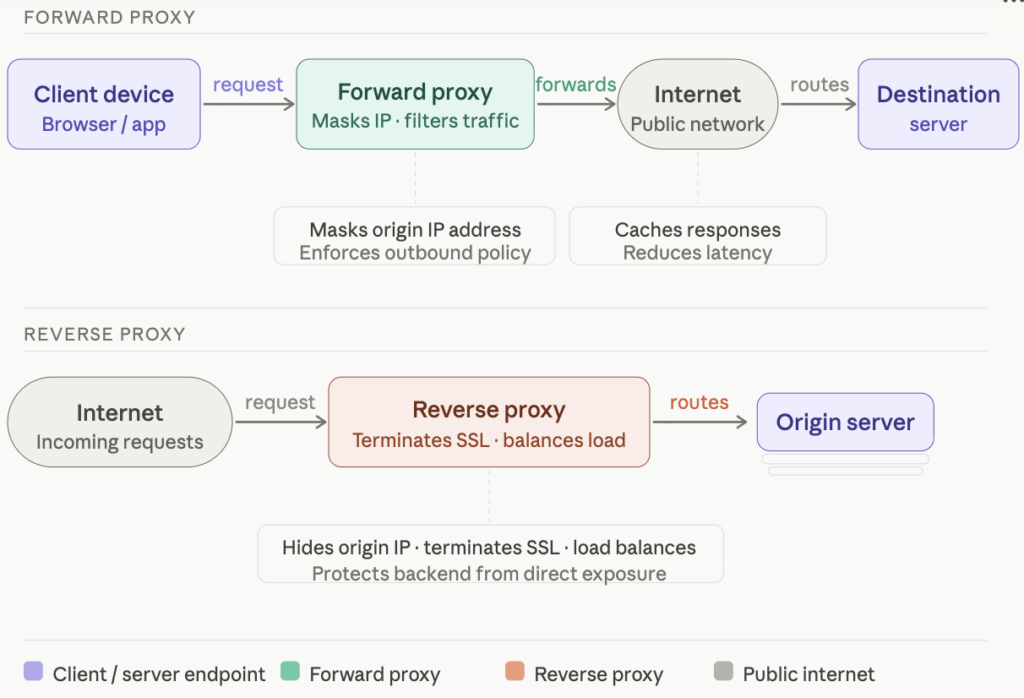
These are the most common type, used to protect clients from direct exposure to the internet. They sit in front of client devices, masking their IP addresses and acting as a gateway to the outside world. A developer building a local proxy with Python might use a forward proxy for testing. They’re invaluable for enhancing security and managing access.
Reverse Proxies
In contrast to forward proxies, reverse proxies sit in front of one or more web servers, protecting them from direct access by clients. They’re often used to load balance traffic across multiple servers, improving performance and availability. They can also provide caching and SSL encryption. Think of them as the bodyguard for your web server, shielding it from potential attacks. For example, they might be used to protect servers handling sensitive data and prevent unauthorized access to internal resources.
Transparent Proxies
These proxies don’t require any configuration on the client side. They intercept traffic without the client’s knowledge. They are often used in corporate networks to filter content or monitor internet usage. They can also be used by ISPs to cache frequently accessed content, reducing bandwidth consumption. They are “transparent” because the user is unaware of the proxy’s presence.
Anonymous Proxies
These proxies hide the client’s IP address, making it difficult to trace the origin of a request. However, they may still identify themselves as a proxy. They provide a basic level of anonymity, suitable for casual browsing. Using this type of proxy can help shield a user’s location information during regular online activities. Anonymous proxies are often chosen when users want to browse the web without revealing their IP address to every website they visit.
Highly Anonymous Proxies (Elite Proxies)
These proxies not only hide the client’s IP address but also do not identify themselves as proxies. They provide the highest level of anonymity, making it very difficult to trace the origin of a request. These proxies are often used by individuals who require a high degree of privacy, such as journalists or activists. Choosing a highly anonymous proxy means that the destination server cannot even detect that a proxy is being used.
SOCKS Proxies
SOCKS (Socket Secure) proxies are more versatile than HTTP proxies. They can handle any type of traffic, including HTTP, HTTPS, FTP, and SMTP. They operate at a lower level of the network stack, providing greater flexibility. They are often used for applications that require a persistent connection, such as online gaming or video conferencing. These proxies offer a wider range of support compared to HTTP proxies, allowing users to manage various types of network traffic through a single, secure connection.
Benefits of Proxy
- Enhanced Security: Proxies act as a buffer between your network and the outside world, mitigating risks. A well-configured proxy can help mitigate cybersecurity risks.
- Improved Performance: Caching frequently accessed content on the proxy server reduces bandwidth usage and improves response times.
- Content Filtering: Proxies can be configured to block access to specific websites or types of content, enforcing corporate policies or protecting users from malicious sites.
- Anonymity: By masking the client’s IP address, proxies provide a degree of anonymity, making it more difficult to track online activity.
- Load Balancing: Reverse proxies can distribute traffic across multiple servers, preventing overload and ensuring high availability.
- Bypassing Geo-Restrictions: Proxies allow users to access content that is restricted to specific geographical regions.
- The global proxy server market is projected to reach $4.7 billion by 2028, driven by enterprise security and remote work demand (MarketsandMarkets, 2023)
Proxy and Access Control
Proxies play a vital role in controlling access to resources, both inbound and outbound. This is particularly important in enterprise environments where security and compliance are paramount.
Inbound Access Control
Reverse proxies can control which clients can access internal servers. By implementing authentication and authorization mechanisms, they ensure that only authorized users can access sensitive resources. They can also filter out malicious traffic, protecting the servers from attacks. This is often coupled with intrusion detection systems to create a layered security approach. For example, a reverse proxy might require users to authenticate with multi-factor authentication before granting access to an internal application.
Outbound Access Control
Forward proxies can control which websites clients can access. This is useful for enforcing corporate policies, preventing access to inappropriate content, and protecting users from malware. They can also log all web traffic, providing valuable insights into user behavior. Additionally, outbound access control helps prevent data exfiltration by restricting access to unauthorized cloud storage services. For example, a forward proxy might block access to social media websites during work hours to improve employee productivity.
Centralized Management
Proxies provide a central point for managing access control policies. This simplifies administration and ensures that policies are consistently enforced across the entire network. Changes to access control policies can be implemented on the proxy server without requiring changes to individual client devices. This centralized approach reduces administrative overhead and improves overall security. Moreover, a centralized system allows for better monitoring and auditing of access attempts.
Integration with Identity Management Systems
Proxies can integrate with identity management systems, such as Active Directory or LDAP, to authenticate users and enforce access control policies based on user roles and groups. This ensures that only authorized users can access specific resources, regardless of their location or device. Integration with identity management systems streamlines user onboarding and offboarding processes. Non-human identities can also be managed and controlled through these integrations.
Challenges With Proxy
While proxies offer numerous benefits, they also come with their own set of challenges. These challenges need to be carefully considered when implementing and managing a proxy infrastructure. Research shows that 68% of breaches in 2024 involved a human or non-human element abusing credentials (Verizon DBIR 2024) and with Machine identities now outnumbering human identities 144:1 in enterprise environments, most of them interact with network infrastructure including proxies (Entro Security).
Performance Overhead
Proxies can introduce performance overhead due to the additional processing required to forward and filter traffic. This overhead can be minimized by using high-performance proxy servers and optimizing the configuration. Caching can also help to reduce the impact of the overhead by serving frequently accessed content directly from the proxy. Regular performance testing and monitoring are essential to identify and address any bottlenecks.
Single Point of Failure
A proxy server can become a single point of failure. If the proxy server goes down, all clients that rely on it will lose connectivity. This can be mitigated by implementing redundancy, such as using multiple proxy servers in a load-balanced configuration. Regular backups and disaster recovery plans are also crucial to ensure business continuity. For larger organizations, a distributed proxy architecture might be more appropriate.
Configuration Complexity
Configuring and managing a proxy server can be complex, especially for advanced features such as content filtering and access control. Proper training and documentation are essential to ensure that the proxy server is configured correctly and securely. Using configuration management tools can help to automate the configuration process and reduce the risk of errors. Furthermore, regular security audits can help identify and address any misconfigurations.
Bypass Techniques
Users may attempt to bypass the proxy server using various techniques, such as using VPNs or other anonymization tools. This can undermine the security policies enforced by the proxy. Implementing detection mechanisms to identify and block these bypass techniques is essential. Regular monitoring of network traffic can help to identify suspicious activity. Education and awareness programs can also help to discourage users from attempting to bypass the proxy.
| Risk | Description | Mitigation |
|---|---|---|
| Credential theft via proxy | Attackers intercept NHI credentials passing through misconfigured proxies | Enforce mTLS; rotate secrets regularly |
| Proxy as C2 channel | Malware uses proxies to disguise command-and-control traffic | Monitor NHI behavior anomalies; inspect egress |
| Bypassing security controls | Users or malware use proxies to evade firewalls and DLP tools | Enforce allowlist-based proxy policies |
| Data exfiltration | Sensitive data exfiltrated through proxied connections | DLP integration at proxy layer |
| Orphaned NHIs in proxy config | Stale service accounts retain proxy access after offboarding | Continuous NHI discovery and lifecycle management |
Proxy Voting and Corporate Governance
Beyond the realm of cybersecurity, the term “proxy” also plays a significant role in corporate governance, specifically in the context of proxy voting.
Shareholder Rights
In corporate governance, a proxy allows a shareholder to delegate their voting rights to another person or entity. This is particularly important for shareholders who cannot attend shareholder meetings in person. The proxy ensures that their voice is heard and that their votes are counted. This is a fundamental aspect of shareholder rights and allows for broader participation in corporate decision-making. Companies are obligated to provide clear and accessible information about proxy voting to ensure that shareholders can make informed decisions.
Proxy Advisors
Proxy advisory firms provide research and recommendations to shareholders on how to vote on various proposals at shareholder meetings. These firms analyze the proposals and provide their assessment of whether the proposals are in the best interests of the shareholders. This can be particularly helpful for institutional investors who may not have the resources to analyze all proposals in detail. Proxy advisors release guidelines annually to align shareholders with corporate governance changes. The influence of proxy advisory firms has grown significantly in recent years, making their recommendations a key factor in many corporate votes. It is also important for shareholders to understand the methodologies and potential biases of these advisory firms.
Impact on Corporate Decisions
Proxy voting can have a significant impact on corporate decisions, such as the election of directors, executive compensation, and major transactions. By exercising their voting rights, shareholders can hold management accountable and influence the direction of the company. This is particularly important in cases where management is not acting in the best interests of the shareholders. Effective proxy voting mechanisms are essential for ensuring good corporate governance and protecting shareholder value. Activist investors often use proxy voting to push for specific changes within a company.
Regulations and Guidelines
Proxy voting is subject to various regulations and guidelines, aimed at ensuring fairness and transparency. These regulations govern the process of soliciting proxies, disclosing relevant information, and counting the votes. The goal is to protect shareholders and ensure that they have the information they need to make informed decisions. Regulatory bodies, such as the Securities and Exchange Commission (SEC), play a key role in enforcing these regulations. Proxy season previews often highlight upcoming regulatory changes and compliance requirements.
Use Cases Beyond Security
While proxies are widely used for security purposes, their applications extend to various other domains.
Web Scraping
Proxies are commonly used in web scraping to avoid being blocked by websites. By rotating through multiple proxy servers, scrapers can mask their IP address and avoid detection. This is particularly useful for scraping large amounts of data from websites that have anti-scraping measures in place. Ethical considerations are important in web scraping, and scrapers should respect the terms of service of the websites they are scraping. Using proxies for web scraping can also help to distribute the load and improve performance.
SEO and Market Research
Proxies can be used to conduct SEO and market research from different geographical locations. By using proxy servers located in different countries, researchers can see how websites rank in different search engines and gather data on local market trends. This information can be used to optimize websites for specific regions and tailor marketing campaigns to local audiences. Proxies also facilitate the monitoring of competitor activities in different markets.
Social Media Management
Proxies can be used to manage multiple social media accounts from a single device. By using different proxy servers for each account, users can avoid being flagged for suspicious activity. This is particularly useful for social media marketers who manage a large number of accounts. Using proxies for social media management can also help to protect the privacy of the accounts. It is important to use reputable proxy providers to avoid compromising the security of the accounts.
Bypassing Content Restrictions
Proxies allow users to bypass content restrictions imposed by governments or organizations. By connecting to a proxy server located in a different region, users can access content that is otherwise blocked. This is particularly useful for accessing news and information in countries with strict censorship laws. However, it is important to be aware of the legal and ethical implications of bypassing content restrictions. Journalists and activists often rely on proxies to access and share information in restrictive environments.
Proxy Security, Non-Human Identity Management, and Agentic AI
Proxy infrastructure doesn’t operate in isolation. Behind every proxy connection, whether from a CI/CD pipeline, a microservice, or a third-party integration, is a non-human identity (NHI) authenticating with a secret: an API key, a service account token, or an OAuth credential.
This is increasingly true for AI agents. As organizations deploy agentic AI systems that browse the web, call external APIs, and orchestrate multi-step workflows autonomously, these agents route traffic through proxy layers just like any other automated system — often with credentials that are broadly scoped, poorly tracked, and rarely rotated. A compromised AI agent credential passing through an enterprise proxy is one of the hardest attack patterns to detect with traditional tooling.
How Entro Can Help
This is where Entro Security comes in. Entro’s platform provides full lifecycle visibility into the NHIs and secrets that interact with your proxy environment, including those belonging to AI agents and MCP servers. When a service account is decommissioned, but its credentials remain active in proxy configurations, that’s a hidden attack surface. When an AI agent is granted excessive permissions to route requests externally, that’s an ungoverned risk. Entro Security automatically surfaces and remediates both.
Entro’s behavioral detection engine, NHIDR™, can also flag anomalous proxy usage by machine identities — such as an NHI or AI agent suddenly routing traffic through an unusual proxy, making requests from an unexpected location, or accessing resources outside its normal scope.
To learn more about how Entro governs NHIs and AI agents across your infrastructure, visit the Entro Security Product page, explore NHI Lifecycle Management, or see how Entro approaches Agentic AI Governance.
People Also Ask
What is the difference between a proxy and a VPN?
While both proxies and VPNs can mask your IP address, a VPN encrypts all of your internet traffic, providing a higher level of security and privacy. A proxy only encrypts traffic for specific applications, such as your web browser. Choosing between a proxy and a VPN depends on your specific needs and priorities. If you require strong encryption and privacy for all of your online activities, a VPN is the better choice. If you only need to bypass content restrictions or hide your IP address for specific applications, a proxy may be sufficient.
Are proxies legal?
Using proxies is generally legal, but it can be illegal if used for malicious purposes, such as hacking or distributing malware. It’s important to use proxies responsibly and in compliance with the law. Certain activities, such as using proxies to commit fraud or engage in illegal activities, are strictly prohibited. Before using a proxy, it’s important to understand the legal implications and ensure that your usage complies with applicable laws and regulations.
How do I choose the right proxy server?
Consider your needs and priorities. If you need high anonymity, choose a highly anonymous proxy. If you need to bypass content restrictions, choose a proxy server located in a different region. Also, consider the performance and reliability of the proxy server. Reading reviews and testing different proxy servers can help you find the right one for your needs. Factors such as speed, location, and security features should be taken into account when making your decision.
What is a proxy server?
A proxy server is an intermediary system that sits between a client (such as a user’s device or an automated service) and the destination server. When a request is made, the proxy forwards it on behalf of the client, masking the original source IP, enforcing policies, or caching content. Proxy servers are widely used for privacy, content filtering, load balancing, and security monitoring.
What is the difference between a forward proxy and a reverse proxy?
A forward proxy sits in front of clients and forwards their requests to the internet. It’s commonly used to anonymize users or enforce outbound filtering. A reverse proxy sits in front of servers and handles incoming requests on their behalf. It’s used for load balancing, SSL termination, and protection against direct exposure. Both serve as intermediaries, but they protect different sides of a connection.
Are proxy servers secure?
Proxy servers can enhance security when properly configured, but they also introduce risk. Misconfigured proxies can be exploited to bypass security controls, intercept traffic, or serve as pivot points in an attack. Non-human identities (NHIs) — like service accounts and API keys — that route traffic through proxies are particularly vulnerable if their credentials are not properly managed and rotated.
How do attackers abuse proxy servers?
Attackers use proxies to anonymize their traffic, bypass geo-restrictions, or route commands through compromised infrastructure (command-and-control proxies). In enterprise environments, they may exploit poorly governed service accounts or stolen API tokens to route malicious traffic through trusted proxy layers, making detection harder. This is why NHI governance is critical in any proxy security strategy.
What is a transparent proxy?
A transparent proxy intercepts traffic without modifying it or requiring client-side configuration. The client may not even be aware a proxy is in use. Transparent proxies are commonly deployed by ISPs or enterprises for content filtering and monitoring. While they are easy to deploy, they offer no anonymization and can raise privacy concerns if not disclosed.
How does proxy usage affect non-human identity security
Many automated systems, including CI/CD pipelines, microservices, and third-party integrations, route their traffic through proxies. These systems authenticate using non-human identities such as service accounts, API keys, or OAuth tokens. If these credentials are compromised, attackers can impersonate legitimate automated traffic through the proxy layer, making the breach harder to detect. Managing the full lifecycle of these NHIs is essential to keeping proxy infrastructure secure.