Key takeaways
- Root certificates are self-signed certificates that sit at the top of every PKI trust chain, issued by a certificate authority (CA) to itself.
- Every HTTPS connection, code-signing workflow, and machine-to-machine authentication ultimately traces its trust back to a root certificate.
- A compromised root CA invalidates every certificate it has ever signed, making root key protection one of the highest-stakes tasks in security operations.
- The CA/Browser Forum approved (April 2025) a plan to reduce maximum TLS certificate validity to 47 days by March 2029, sharply increasing the volume of certificates that teams must manage and rotate.
- The PKI market is growing fast: valued at $5.5 billion in 2025, it is projected to reach $13.64 billion by 2030, driven by cloud adoption, AI workload growth, and tightening compliance requirements.
- AI agents and other non-human identities (NHIs) authenticate using certificates just like humans do, but they outnumber human identities 92:1 at most enterprises, creating a certificate sprawl problem that traditional tools were never built to handle.
What are Root Certificates
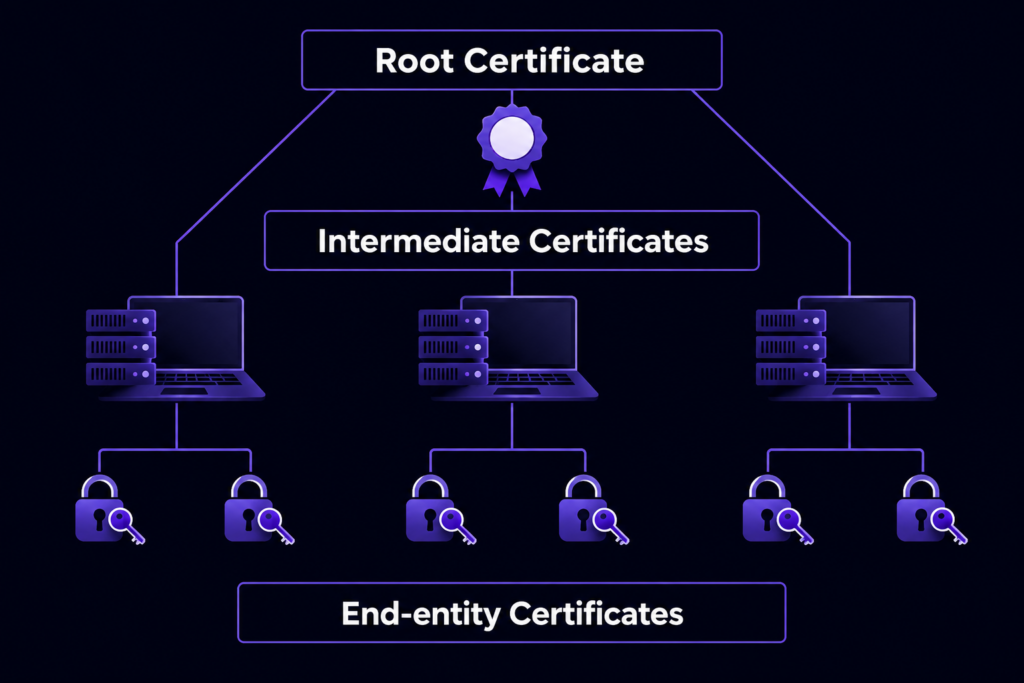
Root certificates form the bedrock of trust in the digital world, acting as anchors for public key infrastructure (PKI). They are self-signed digital certificates, meaning they are issued by a certificate authority (CA) to itself. The private key corresponding to the public key within a root certificate is used to sign intermediate certificates, which in turn sign end-entity certificates, creating a chain of trust. When a client (e.g., a web browser) encounters a certificate, it traces the chain back to a root certificate. If the root certificate is trusted by the client (typically pre-installed in the client’s trust store), then the entire chain is considered trustworthy.
Synonyms
- Trust Anchors
- Root CA Certificates
- Trusted Root Certificates
- Top-Level Certificates
- Self-Signed Certificates (in the context of being the root)
Root Certificates Examples
Imagine a scenario where you’re accessing your bank’s website. The website presents a digital certificate to your browser. Your browser then checks if the certificate was signed by an intermediate CA. That intermediate CA’s certificate was, in turn, signed by a root CA. If your browser trusts the root CA certificate (because it’s in its trusted store), your browser will trust the entire chain and confirm the bank’s website is legitimate. Without that trusted root certificate, the entire system would fall apart.
Another example is software signing. When you download a program, its developers might digitally sign the executable. This signature allows your operating system to verify that the software hasn’t been tampered with and that it originates from a known and trusted source. The signing process relies on a certificate chain that ultimately leads back to a trusted root certificate.
The certificate hierarchy at a glance
| Layer | Type | Signed by | Typical use |
|---|---|---|---|
| Top | Root certificate | Self-signed (CA to itself) | Trust anchor in OS/browser stores |
| Middle | Intermediate certificate | Root CA or another intermediate | Delegates issuance, limits root exposure |
| Bottom | End-entity certificate | Intermediate CA | TLS/HTTPS, code signing, email, device auth |
Understanding where each layer sits helps teams know what to protect most carefully and what an incident at each layer would mean for the rest of the chain.
The Importance of Trust Stores
A trust store is a repository of root certificates that a device or application considers inherently trustworthy. These stores are managed by operating system vendors, browser developers, and other software providers. They undergo rigorous vetting processes to ensure that the CAs included in the trust store adhere to strict security and operational standards. Preparing for the future of cybersecurity involves understanding these foundational elements.
Benefits of Root Certificates
- Establish Trust: They form the foundation of trust in PKI, enabling secure communication and data exchange.
- Enable Secure Transactions: They allow secure online transactions, protecting sensitive information like credit card details.
- Verify Identities: They help verify the identities of websites, software publishers, and other entities.
- Protect Against Man-in-the-Middle Attacks: They prevent attackers from intercepting and manipulating communications.
- Ensure Data Integrity: They guarantee that data hasn’t been tampered with during transit.
- Support Digital Signatures: They enable legally binding digital signatures for documents and transactions.
Understanding Certificate Chains
The concept of a certificate chain is critical for understanding how root certificates work. An end-entity certificate (e.g., a website’s SSL/TLS certificate) is signed by an intermediate certificate. The intermediate certificate is then signed by another intermediate certificate, or directly by the root certificate. This chain of signatures establishes a path of validation from the end-entity certificate back to a trusted root. Each certificate in the chain vouches for the authenticity of the certificate below it. If any certificate in the chain is invalid or untrusted, the entire chain is considered invalid.
Root certificate lifecycle: key stages
| Stage | What happens | Risk if neglected |
|---|---|---|
| Issuance | CA generates a key pair and self-signs the root | Weak key generation leaves the whole chain vulnerable |
| Distribution | Root is submitted to OS/browser trust store programs | Rejection from major stores removes broad trust |
| Monitoring | CA audits compliance with trust store requirements | Non-compliance leads to distrust by major browsers |
| Revocation | Compromised root is removed and certificates re-issued | Delayed revocation allows ongoing exploitation |
| Rotation | CA retires aging roots and transitions to new ones | Expired or deprecated roots break dependent services |
Challenges With Root Certificates
While essential, root certificates present certain challenges. Compromise of a root CA’s private key would have catastrophic consequences, potentially invalidating all certificates issued by that CA. Furthermore, the inclusion of malicious or poorly vetted CAs in trust stores can create security vulnerabilities. Bypassing root certificates can create vulnerabilities and is not recommended.
Root Certificate Revocation
Root certificate revocation is a complex and delicate process. If a root CA’s private key is compromised, all certificates issued under that root must be revoked. This can disrupt services that rely on those certificates and require significant coordination across the industry. Revocation mechanisms like Certificate Revocation Lists (CRLs) and Online Certificate Status Protocol (OCSP) are used to distribute information about revoked certificates.
Root Certificate Management
Effective root certificate management is crucial for maintaining the integrity and security of PKI. This includes carefully vetting CAs before including them in trust stores, monitoring CAs for compliance with security standards, and promptly responding to security incidents. Trust store owners must balance the need for broad compatibility with the need to protect against malicious or compromised CAs. As secret zero is a concern, properly managing root certificates and their corresponding private keys is paramount.
The Role of Intermediate Certificates
Intermediate certificates play a vital role in delegating trust from the root CA to issuing CAs. By using intermediate certificates, root CAs can reduce their exposure to risk. If an intermediate CA is compromised, only the certificates issued by that intermediate CA need to be revoked, not the entire root. Intermediate certificates also allow root CAs to segregate duties and enforce stricter security controls.
Cross-Signing and Legacy Systems
Cross-signing occurs when one CA signs the certificate of another CA. This is often used to bootstrap trust in a new CA by having it signed by a more established CA. Cross-signing can also be used to maintain compatibility with legacy systems that may not trust newer root certificates. Legacy cross-signed root certificates, although useful for backward compatibility, can present unique security challenges as they approach expiration and require careful management.
Root Certificate Updates and Distribution
Root certificate updates are periodically released by operating system vendors and browser developers. These updates include new root certificates, revoked root certificates, and changes to trust store policies. Keeping trust stores up-to-date is essential for maintaining a secure browsing experience. These updates are usually delivered automatically through software update mechanisms.
Creating Your Own Root CA
While typically the domain of large organizations or specialized service providers, creating your own root CA can be useful in certain contexts, such as internal testing or development environments. However, it’s crucial to understand the risks involved. The private key of your root CA must be protected with extreme care. If compromised, it could be used to issue fraudulent certificates that could be used to impersonate legitimate services. Consider using hardware security modules (HSMs) to protect the private key. Creating your own CA requires careful planning and adherence to security best practices.
Compliance and Regulatory Considerations
Organizations that operate their own CAs or rely on digital certificates must comply with relevant industry standards and regulations. These may include requirements for certificate issuance, revocation, and management. Failure to comply with these standards can result in penalties or legal liability. Understanding compliance requirements is crucial for maintaining a secure and trustworthy PKI.
The Future of Root Certificates
The future of root certificates is likely to involve increased automation, improved security, and greater transparency. Efforts are underway to develop more robust mechanisms for certificate revocation and to reduce the reliance on long-lived root certificates. Emerging technologies like blockchain may also play a role in enhancing the security and trustworthiness of PKI. Non-human identities rely on these certificates too, making this a vital area to watch.
Root Store Programs
Root store programs are run by major software vendors like operating system and browser providers. These programs define the requirements and processes for CAs to be included in their respective trust stores. Acceptance into a root store program is a rigorous process that involves demonstrating compliance with strict security and operational standards. Once accepted, CAs are subject to ongoing monitoring to ensure they continue to meet these requirements.
Certificate Authority Authorization (CAA)
Certificate Authority Authorization (CAA) is a DNS record that allows domain owners to specify which CAs are authorized to issue certificates for their domain. This helps prevent unauthorized certificate issuance and reduces the risk of domain spoofing. CAA records are an important tool for improving the security of PKI. Domain owners should carefully configure CAA records to restrict certificate issuance to authorized CAs.
Key Length and Cryptographic Algorithms
The security of a root certificate depends on the strength of its underlying cryptographic algorithms and key lengths. As computing power increases, algorithms and key lengths that were once considered secure may become vulnerable to attack. It’s important to use strong cryptographic algorithms and sufficiently long key lengths to ensure the long-term security of root certificates. Regularly review and update cryptographic configurations to stay ahead of potential threats.
Protecting private keys
The private key of a root certificate is the most sensitive asset a CA holds. Compromise would allow an attacker to issue fraudulent certificates, impersonate legitimate services, and launch man-in-the-middle attacks at scale. Best practices include:
- Regularly testing the security of the environment hosting the root CA.
- Storing root CA private keys in HSMs that provide physical tamper resistance.
- Keeping the root CA offline except during signing operations.
- Enforcing strict, audited access controls on who can interact with the root CA.
Root Certificate Policies
Root certificate policies define the rules and procedures that CAs must follow when issuing and managing certificates. These policies cover a wide range of topics, including identity verification, certificate revocation, and security incident response. Root certificate policies are an important tool for ensuring the consistency and trustworthiness of certificates issued by a CA. Trust store operators should carefully review and assess the certificate policies of CAs before including them in their trust stores.
The Importance of Audit Logs
Comprehensive audit logging is essential for detecting and responding to security incidents related to root certificates. Audit logs should capture all significant events, such as certificate issuance, revocation, and key management activities. Regularly review audit logs to identify suspicious activity. Implement alerting mechanisms to notify security personnel of potential security breaches. Retain audit logs for a sufficient period of time to support forensic investigations.
Root Certificate Pinning
Root certificate pinning is a technique used to mitigate the risk of fraudulent certificates being issued by compromised CAs. With pinning, an application explicitly trusts a specific root certificate or intermediate certificate, rather than relying on the system’s trust store. This can prevent attackers from using fraudulent certificates issued by a rogue CA to impersonate the application’s server. However, pinning can also make it difficult to update certificates if the trusted CA is replaced. Configuring custom HTTPS certificates is complex and requires understanding the risks associated with pinning and revocation.
How root certificates apply to Entro
Root certificates are foundational to how non-human identities (NHIs) and agentic AI authenticate across enterprise environments. Every TLS connection, API call, and machine-to-machine interaction that uses certificate-based authentication depends on a trusted root at the top of the chain.
The challenge today is scale. According to Entro’s own 2025 NHI research, NHIs outnumber human identities 144:1 across enterprise environments, and 47% of NHIs go unchanged for more than a year. AI agents compound this: a single agent deployed to automate a workflow may consume or generate credentials across multiple systems, with certificates among them. The CA/Browser Forum’s April 2025 ruling to reduce maximum TLS certificate validity to 47 days by 2029 means renewal cycles that once took place once a year will need to happen roughly eight times as often, effectively making manual management impossible at any reasonable scale.
Entro’s platform addresses this directly. It discovers certificates across cloud environments, on-premises infrastructure, CI/CD pipelines, SaaS applications, and secrets vaults, including shadow certificates that existing tools miss. Every certificate is mapped to a human owner, establishing accountability for renewals, rotations, and incident response. Entro tracks expiration dates, issues early-warning alerts, and supports automated rotation workflows so that no certificate, whether used by a human service or an agentic AI workload, falls through the cracks.
Entro’s NHIDR capability also monitors for anomalous certificate usage in real time: unexpected certificate authorities, certificates used in atypical contexts, or credentials associated with AI agents that have drifted beyond their intended scope. As AI agents proliferate and certificate volumes rise, unified visibility into root-of-trust relationships becomes a prerequisite for maintaining a defensible security posture.
People Also Ask
What happens if a root certificate is compromised?
If a root certificate is compromised, it’s a severe security incident. All certificates issued under that root CA become suspect. The CA must revoke the compromised root certificate and all subordinate certificates. Browsers and operating systems need to update their trust stores to remove the compromised root certificate. It’s a complex and potentially disruptive process.
How are root certificates distributed?
Root certificates are typically distributed as part of operating system and browser updates. These updates automatically add or remove root certificates from the system’s trust store. This ensures that users have the latest trusted root certificates and that compromised certificates are removed.
What is the difference between a root certificate and an intermediate certificate?
A root certificate is a self-signed certificate issued by a certificate authority (CA) to itself. It’s at the top of the certificate chain. An intermediate certificate is issued by a root CA or another intermediate CA and is used to sign end-entity certificates, such as website SSL/TLS certificates. Intermediate certificates provide a layer of delegation and reduce the risk associated with compromising a root CA’s private key. Understanding the difference is crucial for comprehending PKI.
Why are root CA private keys kept offline?
Keeping the root CA offline reduces the attack surface dramatically. Because the root CA key is only needed when signing new intermediate certificates, which happens infrequently, there is no operational reason to leave it network-connected. An offline root CA cannot be reached by attackers through network-based intrusion, malware, or credential theft.
What is certificate pinning and when should it be used?
Certificate pinning is the practice of hardcoding trust to a specific certificate or CA, bypassing the system’s general trust store. It reduces the risk of attacks using fraudulent certificates issued by a rogue CA. It is most appropriate in high-risk mobile applications or internal tooling where the certificate chain is fully controlled, and less appropriate in public-facing services where CA changes are harder to coordinate.
How do AI agents interact with root certificates?
AI agents authenticate using the same PKI-based mechanisms as other non-human identities: TLS certificates, client certificates, and cryptographic tokens. As agents proliferate (Microsoft Copilot Studio users have already created more than one million AI agents as of 2026), the volume of certificates tied to agentic workloads is growing rapidly, often without visibility or governance. Platforms built for NHI and agentic AI security are designed to surface and manage these credentials at scale.
What is Certificate Authority Authorization (CAA) and why does it matter?
CAA is a DNS record that lets domain owners specify which CAs are permitted to issue certificates for their domain. It prevents unauthorized CAs from issuing certificates for a domain, reducing the risk of spoofing. CAA records are a lightweight but meaningful control that every organization managing public-facing domains should configure.