Key Takeaways
- Symmetric encryption uses a single shared key for both encryption and decryption — fast and efficient, but difficult to scale securely.
- Asymmetric encryption uses a public/private key pair — slower, but solves the key distribution problem and enables digital signatures.
- Most modern systems use a hybrid approach: asymmetric encryption to exchange a symmetric key, which then encrypts the bulk data.
- Encryption keys are a form of non-human identity (NHI) — they must be discovered, secured, rotated, and monitored just like any other machine credential.
- The global encryption software market was valued at $13.5 billion in 2024 and is projected to grow at a 14.4% CAGR through 2034.
- Organizations with strong encryption practices save an average of $360,000 per breach compared to those without (IBM, 2025).
- Entro’s platform — built for Agentic AI and NHI security — provides full lifecycle management for the secrets and keys that underpin your encryption infrastructure.
What is Symmetric vs. Asymmetric Encryption
Symmetric and asymmetric encryption are the two foundational models of modern cryptography, each using a different approach to protect data.
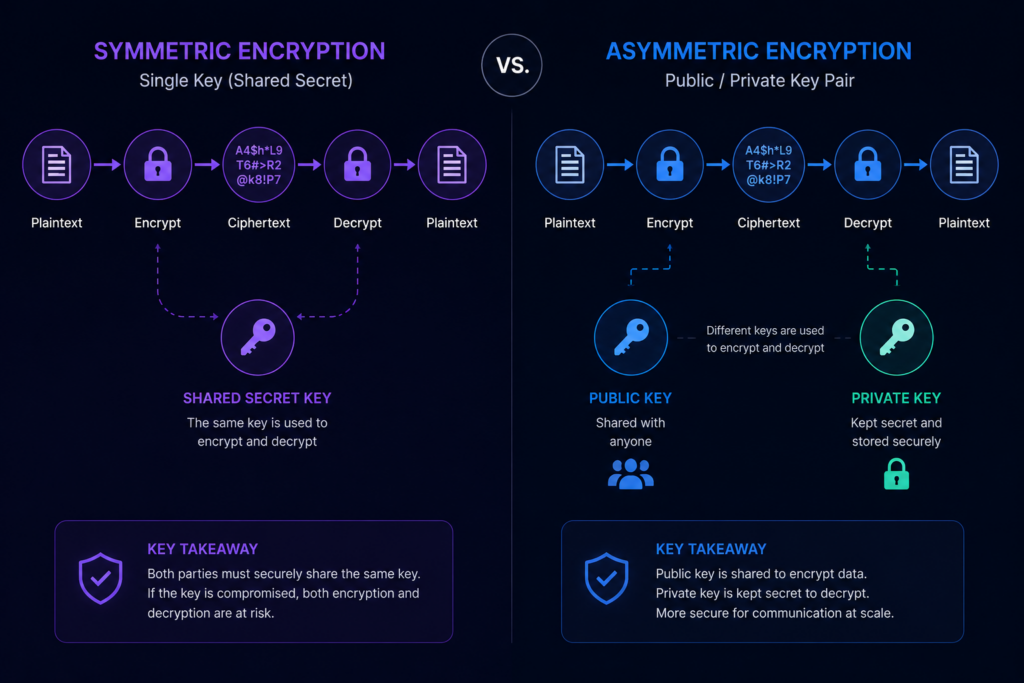
Symmetric encryption relies on a single secret key shared between the sender and receiver. Both parties use the same key to encrypt and decrypt data. It is fast and computationally efficient, making it ideal for encrypting large volumes of data — but it introduces a critical challenge: that secret key must be securely distributed, and if it is ever exposed, every piece of data encrypted with it is at risk.
Asymmetric encryption (also called public-key cryptography) solves the distribution problem by using a mathematically linked key pair: a public key that anyone can use to encrypt data, and a private key that only the owner holds and uses to decrypt it. This eliminates the need to share a secret over the wire, and makes asymmetric encryption essential for digital signatures, certificate trust, and secure initial handshakes — though it is significantly slower than symmetric methods.
In practice, most secure systems today use both: a hybrid encryption scheme where asymmetric encryption handles the key exchange, and symmetric encryption handles the actual data transfer.
Synonyms
| Term | Also Known As |
|---|---|
| Symmetric Encryption | Secret-key cryptography, Conventional encryption, Single-key encryption |
| Asymmetric Encryption | Public-key cryptography, Two-key cryptography, PKI encryption |
Symmetric vs. Asymmetric Encryption Examples
In practical applications, symmetric encryption often finds its niche in securing large volumes of data due to its speed and efficiency. For instance, encrypting a database or securing communication channels within a closed network are common use cases. Algorithms like Advanced Encryption Standard (AES) are frequently employed. Conversely, asymmetric encryption is typically used for key exchange, digital signatures, and scenarios where secure communication is needed with parties that have never interacted before. Secure Sockets Layer (SSL) and Transport Layer Security (TLS) protocols, which secure web browsing, leverage asymmetric encryption for the initial handshake, ensuring the secure exchange of symmetric keys for subsequent data transmission. Understanding the distinct characteristics of each type allows for a more robust approach to cybersecurity risk mitigation.
| Feature | Symmetric Encryption | Asymmetric Encryption |
|---|---|---|
| Keys used | 1 shared secret key | Public + private key pair |
| Speed | Fast | Slow (10–1,000x slower) |
| Key distribution | Difficult — key must be pre-shared | Easy — public key is freely distributed |
| Best for | Bulk data encryption, databases, VPNs | Key exchange, digital signatures, TLS handshakes |
| Common algorithms | AES, 3DES, ChaCha20 | RSA, ECC, Diffie-Hellman |
| Scalability | Harder (requires n×(n-1)/2 keys for n parties) | Scales naturally |
| Quantum resilience | Higher (with larger key sizes) | Vulnerable (RSA, ECC at risk) |
Practical Examples
Symmetric encryption in action: When you access your company’s VPN, AES-256 encrypts the tunnel between your device and the server. A pre-shared key (or one securely exchanged at session start) protects every packet in transit. Similarly, database encryption at rest — protecting millions of records — relies on symmetric algorithms for their speed and low overhead.
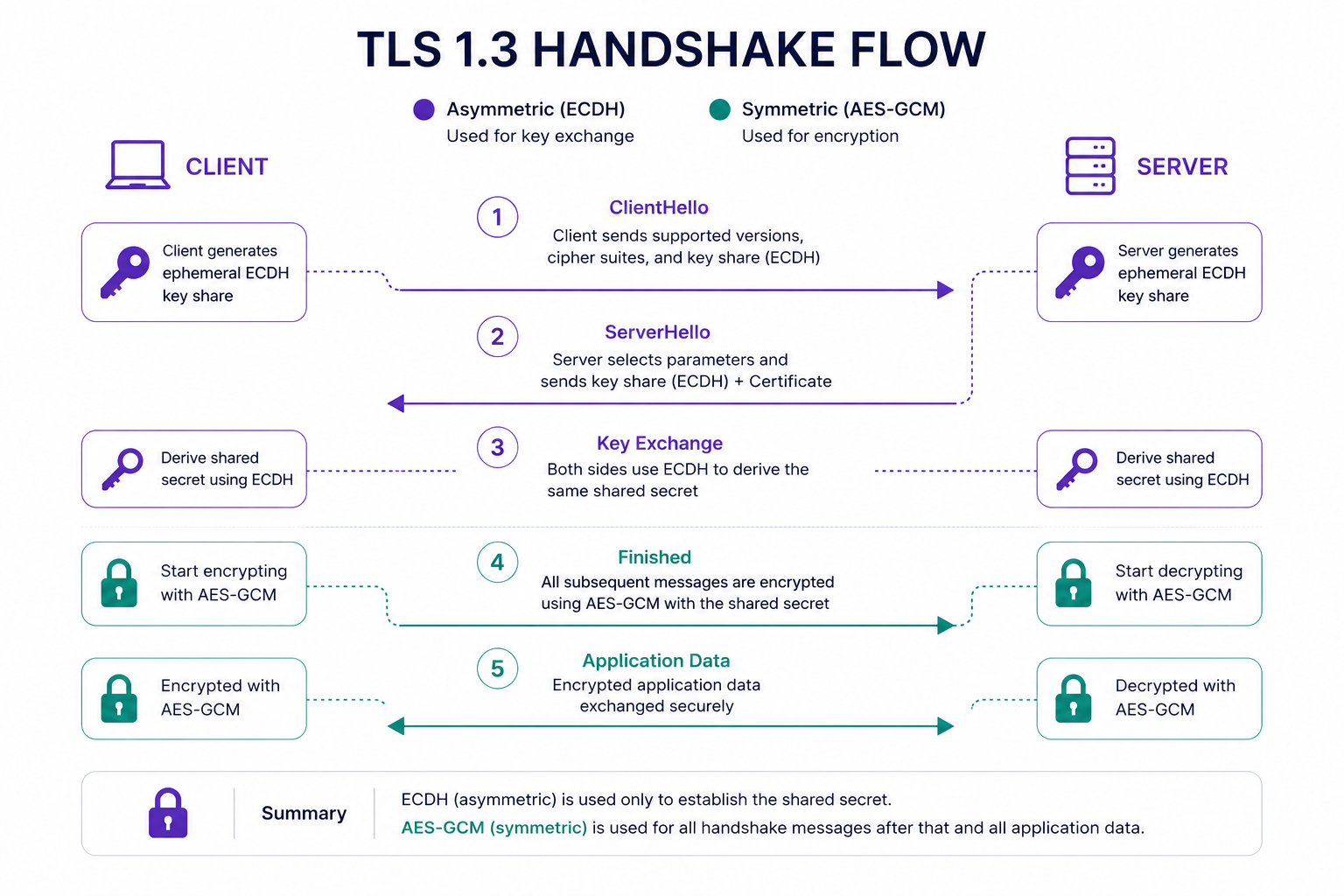
Asymmetric encryption in action: When you open a browser and visit an HTTPS website, your client and the server perform a TLS handshake using asymmetric encryption (typically RSA or ECC) to authenticate the server and exchange a session key. From that point on, the connection switches to symmetric encryption for performance.
Hybrid encryption in practice: PGP (Pretty Good Privacy) email encryption generates a random symmetric key to encrypt the message body, then uses the recipient’s public key to encrypt that symmetric key and attach it. Only the recipient’s private key can unlock it — combining the best of both worlds.
Key Management Challenges
No encryption system is stronger than its key management. This is where many organizations fail.
With symmetric encryption, the key itself is the single point of failure. Anyone who obtains it can decrypt everything. As organizations scale — with hundreds of services, microservices, and cloud environments — distributing and rotating symmetric keys becomes an enormous operational burden. Forgotten or orphaned keys are a persistent risk.
With asymmetric encryption, the private key must never leave the secure environment where it was generated. Private key exposure undermines the entire trust model. Certificate expiration, misconfigured keystores, and shadow key usage are common failure modes in enterprise environments.
According to the 2025 Verizon Data Breach Investigations Report, credential abuse was the initial attack vector in 22% of all breaches — making secrets and key mismanagement one of the most exploited surfaces in enterprise security.
Benefits of Symmetric vs. Asymmetric Encryption
Symmetric encryption excels in its speed and efficiency. Encrypting and decrypting data with a single key consumes significantly less computational power than asymmetric methods. This makes it ideal for encrypting large datasets and high-volume data streams. Asymmetric encryption, on the other hand, provides enhanced security and simplifies key management. The use of separate public and private keys eliminates the need to exchange secret keys, reducing the risk of interception. Asymmetric encryption is particularly useful in scenarios requiring authentication and non-repudiation through the use of digital signatures. It’s crucial to assess security needs thoroughly when deciding between symmetric and asymmetric methods.
Computational Complexity
The computational complexity of encryption algorithms directly impacts the resources required for encryption and decryption. Symmetric algorithms generally have lower computational overhead, making them suitable for resource-constrained environments. Asymmetric algorithms, due to the mathematical operations involved, demand more computational power. This difference in computational complexity is a key factor in determining the appropriate encryption method for various applications. For example, embedded systems with limited processing power may benefit from lightweight symmetric algorithms, while secure web servers can leverage asymmetric encryption for secure communication.
Challenges With Symmetric vs. Asymmetric Encryption
While symmetric encryption offers speed and efficiency, it presents challenges in key distribution and scalability. The need to securely share the secret key among all communicating parties becomes increasingly complex as the number of participants grows. Asymmetric encryption, while simplifying key distribution, faces challenges in computational performance. The encryption and decryption processes are significantly slower than symmetric methods, making it less suitable for encrypting large amounts of data. Vulnerabilities can also arise from improperly configured protocols, as highlighted in asymmetric cryptology exercise error reports.
Use Cases and Applications
Symmetric encryption is widely used in applications such as file encryption, database encryption, and Virtual Private Networks (VPNs). Its speed and efficiency make it a practical choice for protecting large volumes of data at rest or in transit. Asymmetric encryption plays a crucial role in securing digital certificates, email encryption, and secure web communication. It provides the foundation for trust and authentication in many online transactions. A holistic approach to prioritization of remediation within an organization is crucial for effective deployment.
Quantum Computing Implications
The advent of quantum computing poses a significant threat to existing encryption methods, particularly asymmetric algorithms like RSA and ECC. Quantum computers, with their ability to perform complex calculations at unprecedented speeds, could potentially break these algorithms, rendering them ineffective. Symmetric algorithms are considered more resilient to quantum attacks, although their key sizes need to be increased to maintain an equivalent level of security. Post-quantum cryptography research is actively exploring new algorithms that are resistant to both classical and quantum attacks. Studies into hacking cryptographic protocols with advanced variational quantum attacks underscore the need for preparedness.
Hybrid Encryption Schemes
Because symmetric and asymmetric encryption each have complementary strengths, modern protocols almost universally combine them:
- TLS 1.3 (the standard securing HTTPS today): uses ECDH for key agreement, then AES-GCM or ChaCha20-Poly1305 for bulk encryption.
- PGP/GPG: uses RSA or ECC to encrypt a per-message AES key.
- Signal Protocol: uses a combination of Curve25519 (asymmetric) and AES (symmetric) for end-to-end encrypted messaging.
- SSH: authenticates using RSA or Ed25519 keys, then falls back to AES for the session.
The key advantages of hybrid schemes: speed of symmetric encryption for data, security of asymmetric for key exchange, easier key management, and better scalability across multiple recipients.
Encryption Standards and Protocols
The most widely deployed symmetric standard is AES-256, which is the baseline requirement for most compliance frameworks (SOC 2, PCI-DSS, HIPAA, FedRAMP) and is used by government agencies for top-secret data. TLS 1.3 has become the default for all data-in-transit encryption. For asymmetric encryption, RSA-2048 remains common, while ECC (P-256 / P-384) is increasingly preferred for its smaller key size and equivalent security.
As of 2025, over 78% of global cyber insurers require AES-256 and TLS 1.3 as minimum standards to qualify for coverage — a sign of how central encryption standards have become to enterprise risk posture. Further insights into this area are available here.
How This Applies to Entro
Encryption keys — whether symmetric AES keys, RSA private keys, or ECDH key pairs — are secrets. They are non-human identities (NHIs) that authenticate, protect, and authorize access across your infrastructure. And like all NHIs, they can go unmanaged, unrotated, and unmonitored.
This is precisely the problem Entro solves. Entro’s platform, built for Agentic AI and NHI security, treats encryption keys as first-class citizens in your identity security program. As AI agents increasingly operate autonomously — calling APIs, accessing cloud resources, and processing sensitive data — they depend on encryption keys and secrets that must be governed with the same rigor as human credentials.
Entro provides:
- Discovery & Inventory: Automatically find all encryption keys, certificates, and secrets stored in vaults, code repositories, CI/CD pipelines, SaaS tools, and cloud services — including keys used by AI agents.
- Classification & Context: Understand which keys are symmetric vs. asymmetric, what they protect, who owns them, and what access they grant.
- Posture Management: Identify keys that are expired, hardcoded, over-privileged, or unrotated — and prioritize remediation based on actual risk.
- Lifecycle Automation: Automatically rotate secrets and keys before they become exposure windows, including keys used by Agentic AI workflows.
- NHIDR™ (Non-Human Identity Detection and Response): Detect anomalous usage of encryption keys in real time — for example, an AI agent using a private key in an unexpected context or region.
According to Entro’s own research, non-human identities outnumber human identities by 144 to 1 in enterprise environments. The encryption keys securing your data are part of that population — and most organizations have no idea how many they have, where they are stored, or when they were last rotated.
People Also Ask
What are the main differences between symmetric and asymmetric encryption?
Symmetric encryption uses a single key for both encryption and decryption, making it faster but requiring secure key exchange. Asymmetric encryption uses a pair of keys (public and private), simplifying key distribution but being slower computationally.
When should I use symmetric encryption over asymmetric encryption?
Use symmetric encryption when speed and efficiency are paramount, such as encrypting large datasets or high-volume data streams. It is also suitable when you have a secure channel for key exchange.
What are some common symmetric encryption algorithms?
Common symmetric encryption algorithms include Advanced Encryption Standard (AES), Data Encryption Standard (DES), and Triple DES (3DES).
Which is more secure — symmetric or asymmetric encryption?
Neither is universally “more secure.” They address different threats. Asymmetric encryption eliminates the risk of key interception during exchange. Symmetric encryption, when the key is properly managed, provides extremely strong protection with less computational overhead. Modern systems combine both for optimal security and performance.
Why do most systems use hybrid encryption instead of just one type?
Asymmetric encryption is too slow to encrypt large data volumes; symmetric encryption struggles with key distribution at scale. Hybrid schemes use asymmetric encryption to securely exchange a symmetric session key, then symmetric encryption for everything else — combining speed with secure key exchange.
What are the most common symmetric and asymmetric encryption algorithms?
For symmetric encryption: AES-256 (most widely used), ChaCha20-Poly1305, and 3DES (legacy). For asymmetric: RSA-2048/4096, ECC (P-256, P-384), Ed25519, and X25519 for key agreement.
How does quantum computing threaten encryption?
Quantum computers running Shor’s algorithm could break RSA and ECC by solving their underlying math problems efficiently. AES-256 is more resistant — doubling key length counters the quantum speedup from Grover’s algorithm. NIST finalized the first post-quantum cryptography standards in 2024 as organizations begin migration.
What is TLS and how does it relate to both encryption types?
TLS (Transport Layer Security) is the protocol securing HTTPS web connections. It uses asymmetric encryption (ECDH) during the handshake to authenticate the server and establish a shared session key, then switches to symmetric encryption (AES-GCM) for the actual data transfer — a classic hybrid encryption pattern.