Key Takeaways
- An X.509 certificate is a digital credential that binds a public key to an identity (user, server, device, or AI agent), enabling encrypted and authenticated communication over networks.
- X.509 certificates are the backbone of TLS/HTTPS, S/MIME, code signing, and VPNs — and increasingly, machine-to-machine authentication for non-human identities (NHIs).
- Certificate mismanagement is a leading cause of enterprise outages: according to Keyfactor’s 2024 PKI and Digital Trust Report, organizations experience an average of three certificate-related outages every 24 months, costing approximately $2.86 million per incident.
- The CA/Browser Forum approved (April 2025) a schedule to reduce maximum TLS certificate validity to 47 days by March 2029, dramatically increasing the need for automated lifecycle management.
- Entro’s platform — built for Agentic AI and non-human identity security — provides automated discovery, lifecycle governance, and real-time anomaly detection across all X.509 certificates and NHI credentials in your environment.
What is X.509 Certificate
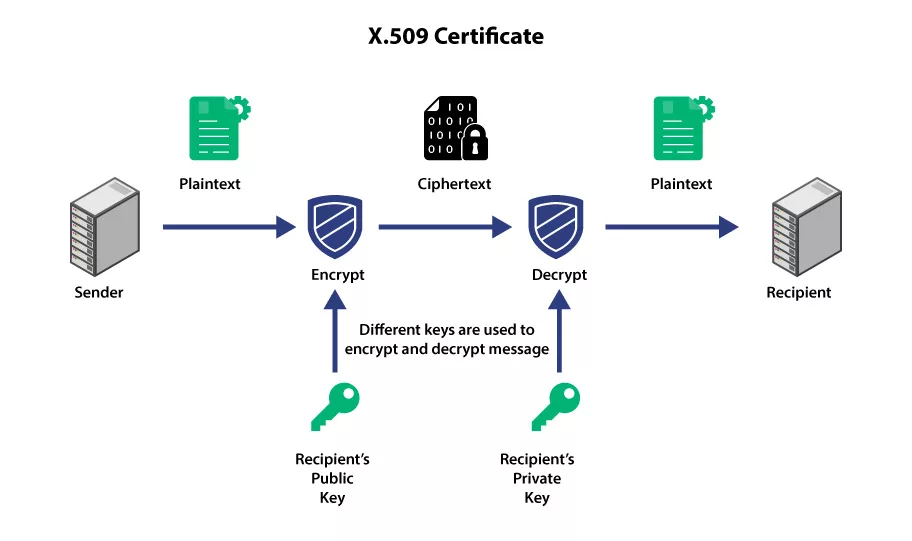
An X.509 certificate is a digital certificate based on the widely accepted X.509 public key infrastructure (PKI) standard. It verifies the identity of a user, server, device, or non-human identity (such as a service account, AI agent, or automated workload) and enables encrypted communication between them.
At its core, an X.509 certificate works like a digital passport. It contains the subject’s name, their public key, the issuer’s details, the certificate’s validity period, and additional metadata — all digitally signed by a trusted Certificate Authority (CA). The CA acts as a trusted third party that verifies the certificate holder’s identity before issuing the credential.
X.509 certificates were first introduced in 1988 alongside the X.500 electronic directory standards and were later adapted for internet use by the IETF’s PKIX working group. Today, they underpin virtually every secure digital interaction: HTTPS web traffic, VPNs, S/MIME email encryption, code signing, and mutual TLS (mTLS) authentication between microservices and AI agents.
Synonyms
- Digital Certificate
- Public Key Certificate
- Identity Certificate
- SSL Certificate (in web/TLS contexts)
- TLS Certificate (in web/TLS contexts)
- PKI Certificate
How X.509 Certificates Work: Real-World Examples
HTTPS / Web Security: When a user visits a website, the browser retrieves the site’s X.509 certificate, verifies it was signed by a trusted CA, and uses the embedded public key to establish an encrypted TLS session. This is the foundation of the padlock icon in every browser.
Code Signing: Software developers sign their applications with X.509 certificates so that users and operating systems can verify the software hasn’t been tampered with. When you install a signed application, the OS checks the developer’s certificate before allowing execution.
Email Security (S/MIME): X.509 certificates enable end-to-end encrypted and digitally signed email via the S/MIME protocol. Recipients can verify the sender’s identity and confirm that the message wasn’t altered in transit.
Machine-to-Machine (mTLS): In zero-trust architectures and microservices environments, both the client and server present X.509 certificates, creating bidirectional authentication. This is essential for securing communication between APIs, services, and — increasingly — AI agents.
X.509 Certificate Structure
Each X.509 certificate follows a standardized structure defined by the X.509 v3 specification (RFC 5280):
| Field | Description |
|---|---|
| Version | X.509 version used (v1, v2, or v3) |
| Serial Number | Unique identifier assigned by the CA |
| Signature Algorithm | Algorithm used to sign the certificate (e.g., SHA-256) |
| Issuer Name | Distinguished Name (DN) of the issuing CA |
| Validity Period | “Not Valid Before” and “Not Valid After” dates |
| Subject Name | DN of the entity the certificate is issued to |
| Subject Public Key | The public key and its algorithm |
| Extensions | Key usage, subject alternative names, CRL endpoints, etc. |
| CA Signature | The CA’s digital signature over all above fields |
Note on validity periods: As of 2025, publicly trusted TLS certificates have a maximum validity of 398 days. In April 2025, the CA/Browser Forum approved a future reduction to 47 days by March 15, 2029, which will significantly increase certificate rotation frequency and the need for automation.
Benefits of X.509 Certificates
- Authentication: Verifies the identity of users, servers, devices, and non-human identities — preventing impersonation and unauthorized access.
- Encryption: Enables encrypted communication so that intercepted data remains unreadable to unauthorized parties.
- Data Integrity: Digital signatures guarantee that data has not been modified in transit. Any tampering invalidates the signature.
- Trust Establishment: Certificate Authorities provide a trusted verification layer, extending institutional trust to end entities and applications.
- Non-Repudiation: Signed transactions are legally attributable to the signer — crucial for contracts, financial transactions, and audit trails.
- Regulatory Compliance: X.509-based PKI helps organizations satisfy requirements under frameworks such as PCI-DSS, HIPAA, SOC 2, and ISO 27001.
Certificate Authorities (CAs): The Trust Backbone
Certificate Authorities are the organizations that issue, manage, and revoke X.509 certificates. They verify an applicant’s identity through document checks, domain validation, or extended validation procedures before signing a certificate with their private key.
Public CAs (e.g., DigiCert, Sectigo, GlobalSign) are pre-trusted by browsers and operating systems. Certificates they issue are automatically recognized by end users without additional configuration. Public CAs are governed by the CA/Browser Forum’s Baseline Requirements.
Private CAs are operated internally by organizations to issue certificates for internal systems — internal APIs, microservices, developer workstations, and AI agents. While flexible, private CA certificates must be manually trusted on all devices that need to recognize them.
Root Certificates
Root certificates are self-signed certificates at the top of the trust hierarchy. They are pre-installed in browsers and operating systems, and their private keys are the most security-critical assets in the entire PKI. Compromise of a root key would invalidate trust for every certificate that chains back to it.
Intermediate Certificates
Intermediate CAs sit between root CAs and end-entity certificates, adding a layer of separation that protects root keys. Most day-to-day certificate issuance — including for TLS, code signing, and mTLS — is performed by intermediate CAs. The chain of intermediate certificates back to a root CA is called the certificate chain or trust chain.
Challenges in X.509 Certificate Management
The Scale Problem
Modern enterprises operate thousands — sometimes hundreds of thousands — of active certificates across cloud infrastructure, SaaS tools, CI/CD pipelines, on-premises systems, and AI agents. According to industry research, 81% of organizations have experienced at least two certificate-related outages in the past 24 months, and the average economic impact of certificate-related downtime and outages totals $67.2 million per company over two years.
The growing use of short-lived certificates (driven by CA/Browser Forum policy changes) and the explosion of non-human identities mean that certificate sprawl is accelerating — and manual management via spreadsheets is no longer viable.
Key Rotation
Regular key rotation limits the damage window if a private key is compromised. Organizations should establish key rotation policies that define rotation frequency and procedures. As TLS certificate lifespans shorten toward 47 days, organizations without automated rotation will face a continuous operational burden.
Certificate Revocation
When a certificate’s private key is compromised — or the certificate is no longer needed — it must be revoked before its expiration. Revoked certificates are published in Certificate Revocation Lists (CRLs). As of March 2024, the CA/Browser Forum updated its Baseline Requirements to make CRLs mandatory and the Online Certificate Status Protocol (OCSP) optional for publicly trusted CAs.
Common Misconfigurations and Risks
| Misconfiguration | Risk | Recommended Remediation |
|---|---|---|
| Weak cryptographic algorithms (MD5, SHA-1) | Certificates vulnerable to collision attacks | Replace with SHA-256 or SHA-384 |
| Expired certificates | Service outages, browser warnings, broken trust | Automated renewal monitoring and alerting |
| Improperly validated certificates | Man-in-the-middle attacks, impersonation | Enforce full chain validation including revocation checks |
| Wildcard certificate compromise | All covered subdomains exposed simultaneously | Isolate scope; rotate immediately if key is suspected compromised |
| Orphaned/untracked certificates | Unnoticed expiration; no owner for remediation | Centralized certificate inventory with ownership attribution |
| Private keys stored in code or CI/CD | Credential theft and lateral movement | Vault integration with least-privilege access policies |
By the numbers: Certificate expiry outages cost enterprises between $500,000 and $5 million per incident and take an average of 5.3 hours to identify and remediate
How X.509 Certificates Apply to Entro
X.509 certificates are a foundational category of non-human identity (NHI) — digital credentials that authenticate machines, services, and AI agents rather than humans. Like API keys, service account tokens, and OAuth credentials, certificates require discovery, classification, lifecycle management, and continuous monitoring.
Entro’s platform — purpose-built for Agentic AI and NHI security — treats X.509 certificates as first-class identities:
- Discovery & Inventory: Entro discovers certificates across cloud environments, on-premises infrastructure, CI/CD pipelines, SaaS applications, and secrets vaults — surfacing shadow certificates and orphaned credentials that existing tools miss.
- Ownership Attribution: Every certificate is mapped to a human owner (the engineer, team, or service that created it), establishing clear accountability for renewals, rotations, and incident response.
- Lifecycle Management: Entro tracks certificate expiration dates, issues alerts well in advance of renewal deadlines, and supports automated rotation workflows — critical as certificate validity periods shrink toward 47 days.
- Posture Management: Entro identifies misconfigured certificates — weak algorithms, overly broad wildcard scopes, certificates with excessive permissions — and prioritizes remediation using AI-driven risk scoring.
- NHIDR™ (NHI Detection & Response): Entro’s proprietary detection engine baselines normal certificate usage patterns for each identity. If a certificate is suddenly used from an unexpected location, by an AI agent acting outside its defined scope, or during an unusual time window, Entro flags it as a behavioral anomaly and triggers automated response.
- Agentic AI Governance: As AI agents increasingly rely on certificates for mTLS authentication with APIs and services, Entro provides complete visibility into which agents hold which certificates, what resources those certificates grant access to, and whether agent behavior is consistent with expected patterns.
For every human user in a modern enterprise, there are 100+ machine identities — and certificates are among the most powerful of them. Entro ensures they are all visible, governed, and secured.
People Also Ask
What is the difference between SSL and TLS certificates?
While the terms SSL and TLS are often used interchangeably, TLS (Transport Layer Security) is the successor to SSL (Secure Sockets Layer). SSL is an older protocol, and TLS is the current standard for secure communication over the internet. Therefore, technically, you should be using TLS certificates. However, the term “SSL certificate” is still widely used.
How do I check if an X.509 certificate is valid?
You can check the validity of an X.509 certificate using various tools and methods. Web browsers typically display a lock icon in the address bar to indicate a secure connection. Clicking on the lock icon will provide information about the certificate, including its validity period and issuer. You can also use online certificate checkers or command-line tools like OpenSSL to examine the certificate’s details and verify its signature.
What is a Certificate Signing Request (CSR)?
A Certificate Signing Request (CSR) is a file containing information about the entity requesting a digital certificate. It includes the entity’s public key and other identifying information, such as the organization name and domain name. The CSR is submitted to a Certificate Authority (CA), which uses the information in the CSR to create and sign the X.509 certificate. The CSR is an essential step in the certificate issuance process.
What happens when an X.509 certificate expires?
Expired certificates immediately break trust — browsers display hard security warnings, applications refuse connections, and services may become completely unreachable. Research indicates the average enterprise experiences three such outages every two years, costing roughly $2.86 million per incident.
What is mTLS and how do X.509 certificates enable it?
Mutual TLS (mTLS) extends standard TLS by requiring both the client and the server to present and verify X.509 certificates. This bidirectional authentication is essential in zero-trust architectures and for securing service-to-service communication — including between AI agents and the APIs they call.cly trusted CAs under CA/Browser Forum rules.
How does certificate revocation work?
Revocation invalidates a certificate before it naturally expires — typically because the private key was compromised. Revoked certificates are published in Certificate Revocation Lists (CRLs), which browsers and applications check before trusting a certificate. As of March 2024, CRLs are mandatory for publicly trusted CAs under CA/Browser Forum rules.