Key Takeaways
- A bearer token is a security credential that grants access to any entity that possesses it — no further identity verification required.
- Bearer tokens are the dominant access credential in OAuth 2.0 and modern API-driven architectures, enabling stateless, scalable authentication.
- Because possession equals access, stolen or leaked bearer tokens represent a critical security risk, and token theft is rising sharply in 2025.
- Secure token management requires short expiration windows, encrypted storage, and active revocation mechanisms.
- Entro’s Non-Human Identity (NHI) Security Platform discovers, monitors, and protects bearer tokens across cloud environments, code repositories, and CI/CD pipelines.
What is Bearer Token
A Bearer Token is a security token, a string of characters, used to authorize access to protected resources. It essentially says, “the holder of this token is authorized to access this resource.” The system trusts the bearer of the token without requiring further identification. Think of it like a physical key – whoever possesses the key can unlock the door, regardless of who they are.
This approach simplifies the authentication process. The client, often a software application, receives a Bearer Token after successful authentication. Subsequently, every time the client requests a protected resource, it presents the token in the HTTP authorization header. The server validates the token and, if valid, grants access. This streamlined process avoids repeated authentication requests, making it suitable for APIs and microservices.
Authorization: Bearer <token>While efficient, the “bearer” aspect implies that possession is key. If the token is compromised, anyone who obtains it can impersonate the legitimate user, underscoring the critical need for secure storage and transmission.
Synonyms
- Access Token
- Authorization Token
- API Key (sometimes used interchangeably, but API Keys often have broader access)
- Auth Token
How Bearer Tokens Work
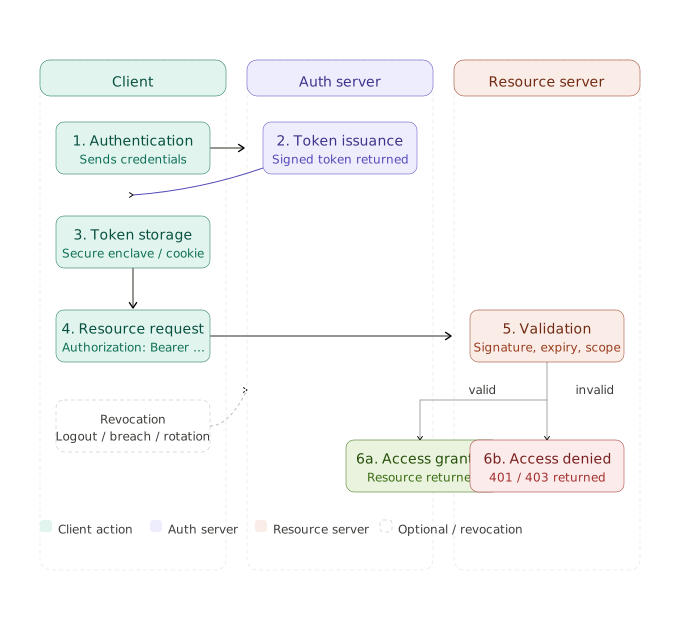
Bearer tokens function as proof of authorization, replacing the need for repeated username and password verification. The typical lifecycle involves six steps:
- Authentication — The user or application authenticates with an authorization server using credentials such as a username and password.
- Token Issuance — Upon successful authentication, the server issues a cryptographically signed bearer token containing user identity, permissions, and a validity window.
- Token Storage — The client securely stores the token. How it’s stored significantly affects overall security posture.
- Resource Request — When the client needs access to a protected resource, it attaches the bearer token to the
Authorizationheader of each HTTP request. - Token Validation — The resource server extracts the token, verifies its signature, checks expiration, and confirms the encoded permissions.
- Access Granted or Denied — A valid token grants access; an invalid or expired token returns an error.
Bearer Token Lifecycle at a Glance
| Stage | What Happens | Key Security Concern |
| Issuance | Auth server generates a cryptographically signed token | Weak signing algorithms |
| Storage | Client persists token (memory, cookie, secure enclave) | Insecure storage enables theft |
| Transmission | Token sent in HTTP Authorization header | Requires HTTPS/TLS to prevent interception |
| Validation | Resource server verifies signature, expiry, scopes | Expired token acceptance |
| Revocation | Token invalidated on logout, breach, or expiry | Lack of revocation mechanism |
Bearer Token Examples
Web API Authentication
Imagine an application needing to access a user’s profile data from a social media platform. Upon successful login, the social media platform issues a Bearer Token to the application. Subsequently, the application includes this token in the “Authorization” header of every request it makes to retrieve the user’s profile. The social media platform’s API verifies the token, and if valid, returns the requested data. This entire process happens without the user having to log in repeatedly for each piece of data accessed.
Mobile Application Authorization
A mobile banking app uses a Bearer Token to allow users to perform transactions. Once the user successfully logs in, the app receives a Bearer Token. This token is then included in every request the app sends to the bank’s servers to perform actions such as transferring funds or viewing account balances. This ensures that only authenticated users with a valid token can access sensitive banking data and perform transactions.
Microservices Communication
Within a microservices architecture, services often need to communicate with each other securely. A Bearer Token can be used for service-to-service authentication. For example, if a “payment service” needs to request information from a “user service”, it presents a Bearer Token obtained previously. The “user service” validates the token before providing the requested user information. This ensures only authorized services can access specific data or functionalities.
Benefits of Bearer Token
- Simplified Authentication: Reduces the overhead of repeatedly authenticating users.
- Improved Scalability: Facilitates stateless authentication in distributed systems.
- Enhanced Security: Can be used in conjunction with other security measures like encryption and multi-factor authentication.
- Fine-grained Access Control: Allows for defining specific permissions associated with each token.
- Delegated Authorization: Enables one service to access resources on behalf of another service.
- Standardized Approach: Widely adopted in industry-standard protocols like OAuth 2.0 and OpenID Connect.
Security Risks & Considerations
While offering numerous benefits, using Bearer Tokens requires careful attention to security. Several vulnerabilities can arise if not properly implemented and managed:
- Token Theft: If an attacker steals a Bearer Token, they can impersonate the legitimate user until the token expires. This can occur through various means, such as phishing attacks, malware, or insecure storage.
- Token Leakage: Accidental leakage of a Bearer Token in logs, emails, or insecure network traffic can expose sensitive resources to unauthorized access.
- Cross-Site Scripting (XSS): XSS vulnerabilities can allow attackers to inject malicious scripts into a web application, potentially stealing Bearer Tokens stored in cookies or local storage.
- Cross-Site Request Forgery (CSRF): CSRF attacks can trick a user’s browser into sending unauthorized requests to a server using the user’s Bearer Token.
- Weak Token Generation: Using weak or predictable token generation algorithms can make it easier for attackers to guess or brute-force Bearer Tokens.
- Lack of Token Revocation: Without a mechanism to revoke compromised tokens, attackers can continue using stolen tokens until they expire.
Mitigating these risks requires implementing robust security measures, including secure token storage, encryption of token transmission, input validation, regular security audits, and a token revocation mechanism. Proper encryption is crucial.
| Risk | Description | Mitigation |
|---|---|---|
| Token Theft | Attacker obtains token and impersonates the user until expiry | Short expiry, HTTPS enforcement, token rotation |
| Token Leakage | Token exposed in logs, URLs, or emails | Log sanitization, avoid tokens in URL parameters |
| XSS Attacks | Malicious scripts extract tokens from cookies or local storage | HttpOnly cookies, Content Security Policy |
| CSRF Attacks | Browser tricked into sending requests with a valid token | CSRF tokens, SameSite cookie attributes |
| Weak Token Generation | Predictable tokens can be brute-forced | Cryptographically secure random generation |
| No Revocation Mechanism | Stolen tokens remain valid until they expire | Implement revocation lists or short expiry windows |
The scale of the threat is significant. <strong>In 2024, infostealer malware exfiltrated over 17 billion browser cookies</strong>, many of them authentication tokens. By replaying a stolen session token, attackers can bypass both passwords and MFA entirely. Meanwhile, <strong>95% of API attacks in 2025 originated from authenticated sessions</strong> — meaning attackers weren’t breaking in, they were logging in with stolen credentials and valid tokens.
Token Storage
How you store a Bearer Token is as important as generating it. Insecure storage can negate the benefits of a strong token generation algorithm and expose your system to vulnerabilities.
Client-Side Storage
When storing Bearer Tokens on the client-side (e.g., in a web browser or mobile app), consider the following options:
- Cookies: Cookies can be used to store Bearer Tokens, but they are susceptible to XSS and CSRF attacks. To mitigate these risks, use the `HttpOnly` and `Secure` flags and implement proper CSRF protection.
- Local Storage: Local storage offers a larger storage capacity than cookies, but it is also vulnerable to XSS attacks. Avoid storing sensitive data directly in local storage. Consider encrypting the token before storing it.
- Session Storage: Session storage is similar to local storage, but the data is only available for the duration of the browser session. This can provide a slightly better security posture than local storage.
- Secure Enclaves: Mobile platforms offer secure enclaves or keychains for storing sensitive data like Bearer Tokens. These provide hardware-backed security and protect against unauthorized access.
Server-Side Storage
Storing Bearer Tokens on the server-side can provide better security, especially for sensitive applications. The server can store the token in a database or cache and associate it with the user’s session. When the client needs to access a protected resource, it sends a session identifier, and the server retrieves the corresponding Bearer Token. This approach reduces the risk of token theft and leakage on the client-side.
Token Revocation
A critical aspect of Bearer Token management is the ability to revoke tokens when necessary. This is essential in situations such as:
- User Logout: When a user logs out of an application, all associated Bearer Tokens should be revoked.
- Password Reset: If a user resets their password, all existing Bearer Tokens should be revoked to prevent unauthorized access with the old password.
- Security Breach: If a security breach is suspected, all Bearer Tokens should be revoked immediately to mitigate potential damage.
- Suspicious Activity: If suspicious activity is detected on a user’s account, the associated Bearer Tokens should be revoked.
Implementing a token revocation mechanism typically involves maintaining a list of revoked tokens on the server-side. When a request is received with a Bearer Token, the server checks if the token is in the revocation list. If it is, the request is denied. There are different approaches to managing the revocation list, such as using a database table, a cache, or a distributed ledger. The method should be appropriate to your infrastructure.
Challenges With Bearer Token
Despite their advantages, Bearer Tokens present several challenges:
- Token Management: Managing the lifecycle of Bearer Tokens, including issuance, storage, revocation, and renewal, can be complex, especially in large-scale systems.
- Security Risks: The inherent “bearer” nature of the token makes it vulnerable to theft and misuse.
- Session Management: Integrating Bearer Tokens with traditional session management can be challenging, especially when dealing with different types of clients and applications.
- Scalability Issues: Validating Bearer Tokens on every request can become a performance bottleneck in high-traffic systems. Caching mechanisms and distributed validation techniques can help mitigate this issue.
- Revocation Propagation: Ensuring that token revocation is propagated quickly and consistently across all services and applications can be difficult, especially in distributed environments.
- Compliance Requirements: Certain regulatory requirements, such as GDPR and HIPAA, may impose specific requirements on how Bearer Tokens are handled and protected.
Choosing Token Expiration Times
The expiration time of a Bearer Token is a crucial parameter that balances security and usability. Shorter expiration times reduce the window of opportunity for attackers to exploit stolen tokens, but they also require more frequent re-authentication, which can impact the user experience. Longer expiration times improve usability but increase the risk of compromise.
There is no one-size-fits-all answer to what the optimal expiration time should be. It depends on several factors, including the sensitivity of the data being protected, the frequency of user activity, and the security posture of the system. Factors impacting this decision include:
Sensitivity of Data
For highly sensitive data, such as financial information or personal health records, shorter expiration times are recommended. This reduces the potential damage if a token is compromised.
User Activity
If users are frequently accessing protected resources, longer expiration times may be acceptable, as the risk of a stolen token being used for an extended period is lower. However, even with frequent activity, consider implementing mechanisms to detect and mitigate suspicious behavior.
Security Posture
If the system has strong security controls, such as multi-factor authentication and intrusion detection systems, longer expiration times may be acceptable. However, it’s essential to regularly review and update security controls to maintain a robust security posture.
A common practice is to use short-lived access tokens and refresh tokens. The access token is used for short-term access to protected resources, while the refresh token is used to obtain a new access token when the old one expires. Refresh tokens can have longer expiration times but should be carefully protected.
Bearer Token vs Other Authentication Methods
Bearer Tokens are one of several authentication methods used in modern applications. It is useful to understand the differences between these methods to make informed decisions about which one to use in a given situation.
Bearer Tokens vs. API Keys
API keys are often used for authenticating applications rather than individual users. While both API keys and Bearer Tokens provide access to protected resources, API keys typically have broader permissions and longer lifespans than Bearer Tokens. API keys are often static and embedded directly into the application code, making them more susceptible to compromise. Bearer Tokens, on the other hand, are typically obtained through an authentication process and can be revoked or refreshed.
Bearer Tokens vs. Cookies
Cookies are commonly used for maintaining session state in web applications. While cookies can be used to store authentication information, they are susceptible to XSS and CSRF attacks. Bearer Tokens, when used with proper security measures, can provide a more secure alternative to cookies for authentication. However, cookies are still widely used for other purposes, such as tracking user preferences and storing session data.
Bearer Tokens vs. Mutual TLS
Mutual TLS (mTLS) is a security protocol that requires both the client and the server to authenticate each other using digital certificates. mTLS provides a high level of security, but it can be more complex to implement and manage than Bearer Tokens. mTLS is often used in scenarios where strong authentication and confidentiality are required, such as in financial transactions or government communications.
| Method | Typical Use Case | Lifespan | Revocable | Stateless |
|---|---|---|---|---|
| Bearer Token | API auth, OAuth 2.0 flows | Short (minutes–hours) | Yes | Yes |
| API Key | Application-level access | Long (months–years) | Yes (manual) | Yes |
| Cookie Session | Web browser sessions | Session-scoped | Yes | No |
| Mutual TLS (mTLS) | High-assurance service-to-service | Certificate lifespan | Yes | Yes |
How Bearer Token Security Applies to Entro
Bearer tokens represent one of the most prevalent and high-risk categories of Non-Human Identities (NHIs). In modern organizations, the number of NHIs — service accounts, API integrations, CI/CD pipelines, AI agents — can outnumber human identities by 50 to 1. Each carries its own bearer token or API key, and most are never monitored after issuance.
This is exactly the problem Entro was built to solve.
Entro’s NHI Security Platform discovers, classifies, and monitors bearer tokens and all associated secrets across cloud environments, code repositories, vaults, CI/CD systems, and collaboration tools. Where traditional security approaches reactively scan for leaked secrets, Entro provides full lifecycle management — from the moment a token is created to the moment it should be retired.
Specific capabilities relevant to bearer token security include:
- Secrets Discovery — Identifies bearer tokens, API keys, and credentials scattered across 1,200+ NHI and secret types, including hard-coded tokens in source code.
- Posture Management — Detects misconfigurations such as overly permissive scopes, missing expiry settings, and tokens stored outside approved vaults.
- Automated Rotation — Enforces rotation policies and actively rotates at-risk tokens without disrupting dependent services.
- NHIDR™ — Entro’s proprietary Non-Human Identity Detection & Response engine establishes behavioral baselines and fires real-time alerts on anomalous token usage.
- Blast Radius Analysis — Maps what resources and systems a compromised token can reach, prioritizing remediation by risk severity.
- Lifecycle Governance — Detects stale and orphaned tokens — credentials that were never decommissioned — and removes them to shrink the attack surface.
Given that authorization issues now rank #1 on OWASP’s API Security Top 10, and that bearer token theft continues to drive high-profile breaches across industries, organizations can no longer afford a passive approach to token management. Entro brings the same rigor applied to human identity security to the machine identity layer — where the greatest visibility gap exists today.
People Also Ask
What is the difference between a Bearer Token and an OAuth token?
While the terms are sometimes used interchangeably, they are not exactly the same. An OAuth token is a more general term referring to a token issued by an OAuth 2.0 authorization server. A Bearer Token is a specific type of OAuth token that uses the “bearer” scheme for authorization, meaning possession of the token grants access. Other OAuth grant types might use different authorization schemes.
How long should a Bearer Token be valid?
There is no universally “correct” lifespan. It depends on the sensitivity of the data being protected, the frequency of user activity, and your overall security posture. Shorter lifespans are generally more secure, but require more frequent re-authentication. Many systems use short-lived access tokens combined with refresh tokens for a balance of security and usability. A common practice is to set access tokens to expire in 15 minutes to an hour, and refresh tokens to expire in days or weeks.
What are the best practices for storing Bearer Tokens in a web application?
Avoid storing Bearer Tokens in local storage due to the risk of XSS attacks. Consider using HTTP-only cookies with secure flags and CSRF protection. For single-page applications (SPAs), storing tokens in memory and retrieving them as needed can be a good approach, but be mindful of memory leaks and the potential for attackers to access the token if they compromise the application’s memory. Server-side storage, if feasible, offers the highest level of security.
Can a bearer token be used after it expires?
No. A well-implemented resource server will reject any token past its expiration timestamp. The client must use a refresh token to obtain a new access token. Systems that fail to validate expiry — or that have no expiry set — are vulnerable.
What is the difference between a bearer token and an API key?
API keys are typically static, long-lived credentials associated with an application rather than a user. Bearer tokens are dynamic, short-lived, and obtained through an authentication flow. API keys often have broader access and are more commonly hard-coded (making them riskier to manage at scale). Bearer tokens are more granular and revocable.
What happens if a bearer token is stolen?
The attacker can impersonate the legitimate user or service for the duration of the token’s remaining validity — without needing a username or password. This is why short expiry times, token revocation mechanisms, and behavioral monitoring (such as Entro’s NHIDR™) are critical controls.
How do bearer tokens relate to non-human identity security?
In most enterprise environments, the majority of bearer tokens are held by machines — CI/CD pipelines, microservices, API integrations — not humans. These non-human identities are often poorly governed: tokens are never rotated, permissions are overly broad, and ownership is unclear. Non-human identity security platforms like Entro are purpose-built to manage this at scale.
What is token revocation and why does it matter?
Token revocation is the ability to invalidate a bearer token before it naturally expires. It matters because if a token is compromised — through a breach, a user offboarding, or suspicious activity — there needs to be a way to cut off access immediately. Without revocation, an attacker can continue using a stolen token until expiry, which could be hours away.